
Rom3n wroteSo it is true that with a full exhaust whether catless or HFC a custom tune is beneficial?The only time you would need to custom tune the MSS60 is if you had major modification such as modified displacement, aftermarket cams, forced induction or a full catless exhaust that had some sort of problem making power at certain RPM’s requiring different cam settings to work optimally.
31KVIEWS
193REPLIES
100APPRECIATES
06-26-2022LAST POST
Rom3n wroteThis information is a great help. Even though it is an adaptive system does it use tables to as a reference as it adapts. For instance for Fuel & Spark a Optimum table a limp table and maybe one in between. Then the engine management moves between the table depending on cylinder burn conditions. Are the core tables (if they are tables) even accessible?The operating system that runs the MSS60 is very sophisticated. It cannot be thought of like the older systems that would benefit from custom tuning. On older systems you could assign values like timing for specific RPM’s based on fuel quality and other factors. On these older systems you can benefit from custom tuning if the tuner knows what he is doing. On newer systems these rules have all changed
On this car the operating system is a self correcting, adaptation based platform. How it works is you pre-select a target for things like AFR and ignition timing targets. The ECU will always execute that target when it can. If the target cannot be reached due to fuel quality, AIT’s or any other reason it will self correct to run as close to target as it can while keeping the motor safe. Each cylinder in the S65 is monitored independently for optimal timing. When corrections need to be made due to variances such as cylinder pressure the ECU will custom tune the spark for that cylinder. This system allows the car to always perform at an optimum level regardless of the situation or condition of the motor. Because of this there is no way to custom tune it. You can cheat by setting targets much higher than the ECU can correct but this is never a good idea as you are simply forcing the ECU to run settings it knows is unsafe.
The only changes you can make to the system outside of what it self corrects are things like vanos calibration, larger fuel injectors calibration cylinder displacement calculations, torque limits, rev limit, top speed governor etc.. these are all things that can be modified to improve performance but none of these would need to be custom tuned for a stock motor or a car running simple bolt on mods. The only time you would need to custom tune the MSS60 is if you had major modification such as modified displacement, aftermarket cams, forced induction or a full catless exhaust that had some sort of problem making power at certain RPM’s requiring different cam settings to work optimally.
If the "Fuel and ignition" tables don't require tuning on a stock engine with bolt on parts due to that adaptive nature of the ECU, you should be able to extract the most performance by using the lowest octane fuel to keep the engine constantly in the optimum range weather it is 91, 93, 94, 100 ron.
Given the information most of the performance would be gained in vanos tuning. How many degrees of adjustment do the cams have? In my experience VTC NA engines the optimum cam angle change with different bolt on configurations (More than mufflers and Air Filters). This along with the other parameters would be the only items for custom tuning.
PencilGeek wroteNo ProblemThanks for clearing that up.
PencilGeek wroteI tell them that the tolerances are incredibly small between each engine which is a fact. I then show them a very large database of dyno runs a basic example of many standard M3’s and low and behold they are all roughly the same with attention being drawn to the graph shapes being identical.So how do you respond to the guys who say that each motor is built differently and therefore benefits from a custom tune?
A question can arise from the above – ‘why are some cars making different power on different dyno’s. We answer this by explaning that different dyno operators may use different ways to dyno cars and comparing different dyno’s is a futile exercise in most cases.
Then we show them the maps from different cars and it clearly shows that the values in the maps are identical.
Then we ask the question – why did BMW not custom tune each vehicle? It’s not just luck that every M3 makes the same power curve and value from the same engine and same map.
Normally, that’s enough for them to understand.
The ones that get pulled into the marketing talk of custom tuning will go elsewhere and one day will realize they’ve been bent over.
PencilGeek wroteMy Origional Post:Can you elaborate a bit more about this? One reader up above asked if this was true even for different catalytic, cross-pipe, and exhaust options. Can you respond to his question on that?
You can sit there all day trying to adjust the tune specifically for alot of the bolt on parts. It won't make a difference in the power output of the engine.
Most of good ones will flow just aswell as each other. Even if there is a difference in power output it will be very small.
The EGT’s, AFR’s and power curve are all similar so what is that we can change? The timing? The Limiters? Won’t make a difference. The similar EGT’s, AFR’s and power curves/graphs are enough evidence thatno changes are required on top of the tune that was already developed for one of those exhausts.
They are just pipes with slightly difference cat configurations and it just doesn’t make much of a difference when you try and tune each one individually. By comparing them (the good ones) we really are splitting hairs! It’s not so different to testing one free flow filter to another.
The basic restriction in the system is the primary cats. Yes, the post O2 sensors do need to be dealt with but that’s the case with most of the systems and therefore it’s the same change required one or more tables to overcome the issue.
I can only speak for the brands we have tested which are all excellent.
PencilGeek wroteA stroker engine will have completely different ignition, fuel and cam timing map value requirements along side many other maps which I do not wish discuss for obvious reasons. Think Limiters.People thought that tuning the stroker was just as simple as modifying a few table entries.
If the injectors are being changed also then there are even more maps to change.
The first step is to identify which maps need changing. Then they have to be scaled correctly so you know what the actual values are. You’d be surprised at how many tuners who cannot scale the values within a map so it’s not just a number!
Identifying the maps is the single most difficult task.
Then, once you’ve made your project file you need a strategy to map. Some strategies are better than others.
This is where the software programming expertise is no longer that important but the tuners skill to make the correct changes to the values within the maps based on feedback they get from their data logging devices (both live and recorded). Generally the mapping will be split into 3 segments – Idle, Part Load and Full Load. Idle can be tricky. Full Load is usually a very quick process because the maps for full load are not very big and you can use a dyno to do 95% of the work. When I say quick I mean relatively quick to part load! It still takes a quite some time. Part load is the hardest one of all because this has the largest number of load sites. In other word it takes a lot of time and as many load sites as possible (ideally all) need to be tested to make sure timing and fuel requirements are met to a very high level of precision.
In theory what people think is ‘basically’ correct. Values in the map tables need to be changed. There are quite a few though (therefore lots of variables!) and the hardest part is knowing where those maps are, what the values should be scaled to and then what to changes need to be made to those values based on the testing and datalogging they do. Do not think it’s just some percentage change you can apply across the board. If only it were that easy!
If anyone thinks it’s easy I am sure one of the tuners out there will happily provide a full project file to work from, train the individuals how to use the software and then send them on their merry way to go and make the engine run as it should.
Infact, Evolve are just in the process of doing our final tests on an E92 M3’s running on pure LPG. This car when it turned up would hardly start up, would not idle and would basically do nothing. Much worse than a stroker situation. We were dealing with a fuel which has a completely different density (98% Propane), has a different burn, different pressure (which in this setup is constant rather than variable) and has the potential to ruin an engine if the fuel and timing requirements are not met within a very small range. Coupled with an ECU which is this sophisticated the task was not particularly easy. If anyone here thinks it’s just a bunch of tables with some basic changes made then come over and try and make one of these cars run like a normal road car (like we have mapped it to do).
When your dealing with strokers, superchargers, fuel changes and anything that drastically changes the way the engine will operate, a tuner is required which has more than just the understanding of how to extract some power out of an engine. This is real custom tuning and it’s applied because it’s really needed!
What Roman and I are trying to say is that the ECU’s can adapt to a certain limit. Most bolt on parts do not make enough difference that there is so much change required which the ECU cannot make small changes for by adaptation.
Custom tuning is only required when something is done to the engine which changes things so drastically that it’s outside of the scope of the adaptation because the base maps are nowhere near where they need to be.
Some tuners may have more than one type or level of tune. Different tuners may have different methods of extracting power. Some methods are better than others.
Once those tunes are developed and that’s all the tuner knows, there is not much else they can do over and above those tunes to cater for bolt on upgrades which the ECU can already handle in it’s normal operation.
masitr wroteI think maybe you are misunderstanding what's been written and what scenario it relates to.They make it sound like the A/F and IGN tunes itself and they just tune the other parameters. I don't believe that to be true. Look at the graphs below from this Plenum upgrade thread I referance earlier. The 12:1 should not be there and be able to adapt itself to stock 14:1
http://www.m3post.com/forums/showthread.php?p=6822001.

Quick discussion on the dyno graph:
14.1 AFR is not a very good target to have under full at high rpm. That's too lean. It's fine for partial load driving or in other words when you foot is not on the floor and the engine is not under full load.
All dyno tests are carried out under full load (foot on floor). The ECU target AFR for full load is between 12.5 and 13 AFR at high rpms.
The AFR's in the graph seem pretty much in that region. Remember, that the target can be changed by the ECU based on other sensor inputs. If for example the air intake temperature starts rising it will take the target AFR and add fuel to that to compensate for the higher temperatures.
Without knowing the variables such as intake temperature of those particular dyno runs, we cannot establish why the AFR went slightly richer at high rpms.
Typically the AFR does move up and down between dyno runs on a standard car.
Just a quick side step and observation on that dyno graph:
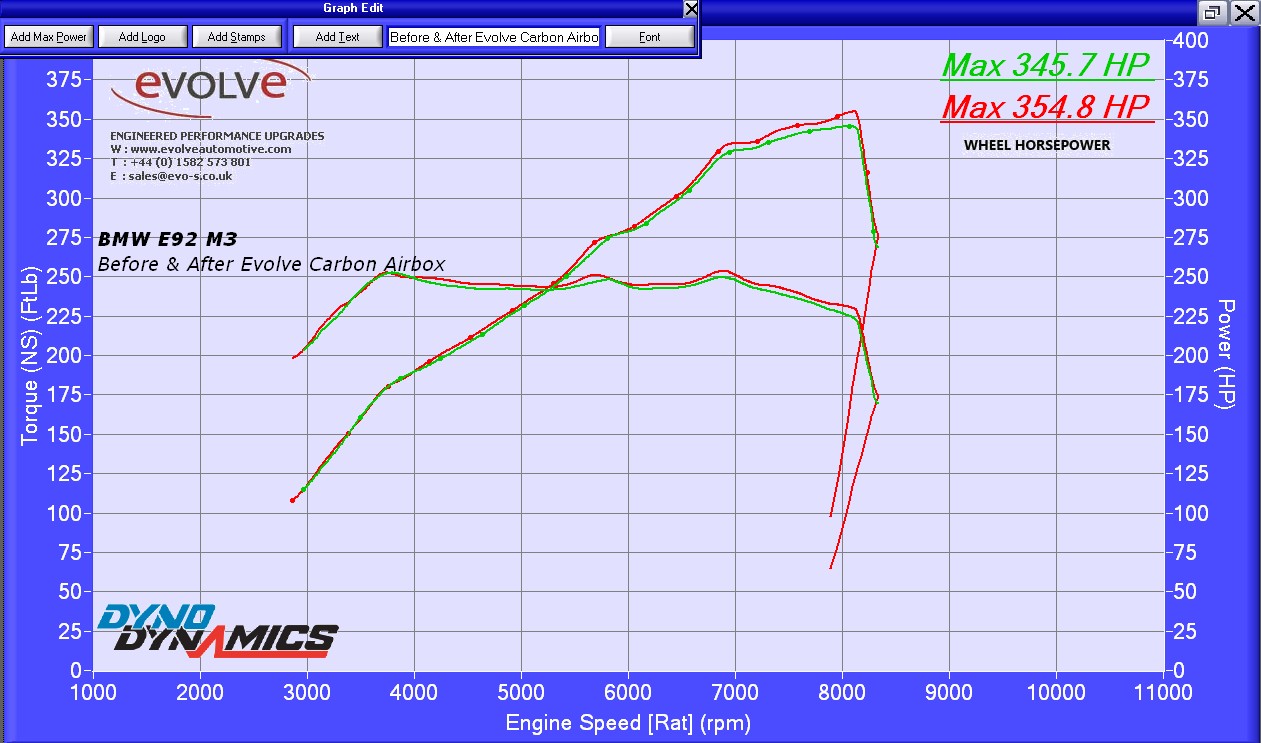
That curve is really not a very good representation of how an M3 makes it's accross the RPM range. These engines do not make pretty much constant power from 7250rpm - 8400rpm.
Below is a representation of what an M3 does in tuned standard form with a comparison of an intake.....look at what happens on the standard graph at high rpm.... power does not remain constant but rises!
sal,
on dct cars, what gear and mode do you dyno the car in?
thanks
on dct cars, what gear and mode do you dyno the car in?
thanks
4th Gear for DCT and 3rd for 6MT.
If you dyno a 6MT in 4th gear the results are like 30hp higher everywhere
5th DCT same applies.
If you dyno a 6MT in 4th gear the results are like 30hp higher everywhere
5th DCT same applies.
Sal@Evolve wrotethats what i thought as well4th Gear for DCT and 3rd for 6MT.
If you dyno a 6MT in 4th gear the results are like 30hp higher everywhere
5th DCT same applies.
also, whats the best way to get into dyno mode on these cars w/the dct...do you have a set of steps 4 it? There seems 2 be no clear set of steps anywhere on how 2 do so
thanks
Turn off the traction and drive the car at low rpm's for a few seconds. ABS lights will appear and then go ahead and change gear and dyno the car.
Do you have your own dyno?
Do you have your own dyno?
Sal@Evolve wrotenoTurn off the traction and drive the car at low rpm's for a few seconds. ABS lights will appear and then go ahead and change gear and dyno the car.
Do you have your own dyno?

Just going to the dyno in the next few weeks and wanted 2 insure I was doing it properly...it is a dyno dynamic dyno as well
DCT also puts less power to the wheels, (compared to 6 speed) so I'm told......
Drivetrain losses are greater?? Makes sense.
Drivetrain losses are greater?? Makes sense.
2010e92m3 wroteMust ask gearbox manufacturer this question.DCT also puts less power to the wheels, (compared to 6 speed) so I'm told......
Drivetrain losses are greater?? Makes sense.
In theory it's just a manual gearbox.
2010e92m3 wroteI hear they just read lower on dynos but that doesn't mean they are slower than a 6MTDCT also puts less power to the wheels, (compared to 6 speed) so I'm told......
Drivetrain losses are greater?? Makes sense.
2010e92m3 wrotecouldn't be enough to measure i would thinkDCT also puts less power to the wheels, (compared to 6 speed) so I'm told......
Drivetrain losses are greater?? Makes sense.
I'd be interested in what this gentleman has to offer. I approached diablosport at the PRI show and they said they had a solution to the M3 hand held flash tune but I guess they're full of it. They had this nifty little mini iphone looking programer that looked promising.
Anyone in S. Florida Interested in Playing with ECU Tunes?
Anyone in S. Florida Interested in Playing with ECU Tunes?
We have a cable being released very soon which you get to keep and you can flash the car back to stock when ever you like. Also, if you need some changes made to the software because you've done something that warrants it then we just send you a new file.
sales@ESSTuning wroteBringing this thread back from the afterlife!Sal@Evolve wroteThis is correct.Unless your car is 'custom' there is no benefit of a custom tune.
Even if your car is custom then there may already be a tune out there for that setup.
The mechanical tolerances are extremely small accross these engines.
Unless of course you want a custom type of map such as specific changes to the throttle maps or purely driveability modifications and no full power changes etc etc.
The MSS60 will adapt and make corrections on the fly for each cylinder in the S65 motor when needed. Most tuners have software for small changes like catless exhaust systems that work perfectly fine. The only reason anyone would ever need a custom tune on this car is if they wanted something specific like a custom RPM limit, idle or they made a significant change such as cams or higher displacement.
So, just wanted to clarify… All tunes are essentially the same in regards to performance?
The only differences are optional changes like higher redline or coding out cats, Etc?
SilverSlug wroteNo.sales@ESSTuning wroteBringing this thread back from the afterlife!Sal@Evolve wroteThis is correct.Unless your car is 'custom' there is no benefit of a custom tune.
Even if your car is custom then there may already be a tune out there for that setup.
The mechanical tolerances are extremely small accross these engines.
Unless of course you want a custom type of map such as specific changes to the throttle maps or purely driveability modifications and no full power changes etc etc.
The MSS60 will adapt and make corrections on the fly for each cylinder in the S65 motor when needed. Most tuners have software for small changes like catless exhaust systems that work perfectly fine. The only reason anyone would ever need a custom tune on this car is if they wanted something specific like a custom RPM limit, idle or they made a significant change such as cams or higher displacement.
So, just wanted to clarify… All tunes are essentially the same in regards to performance?
The only differences are optional changes like higher redline or coding out cats, Etc?
You can not compare some cheap tune to something that has undergone proper development. Usually you get what you pay for. Our software underwent thousands of hours of testing before release, on track and road, including both temperature extremes. Others that provide "tunes" probably haven't used a dyno in their life and have zero actual development/testing other than using customers as guinea pigs. But people still buy it because a good deal is always what it seems right?
We have tuned thousands of M3s in over 50 countries around the world, pioneered many features on this platform, and offer the best and most knowledgeable support. Unfortunately this doesn't stop many from going with a far less experienced option because shooting flames is cool….

While gains on a naturally aspirated engine tune will likely be similar, full throttle increases are only a small fraction of the pie. Part throttle drivability, safety and other protections, and many other factors are often overlooked. This is why many often switch to different software, but to be honest half the people don't even know that the software they use is calibrated terribly, and fortunately many of the factory software controls will prevent damage that could otherwise occur. The majority of tunes simply change the throttle mapping and the customer thinks their car is so much faster. The reality is that it's not, and they've lost the fine control of the gas pedal they once had. in retuning thousand of cars, the things i have come across are mind blowing. We do not increase the pedal response map over the factory values at all in our software, as we want the gains to be achieved through careful consideration of parameters which are an art and a science, and not artificially achieved. we've also built further enhancements to protect the engine and limit output even sooner than the factory software does.
BPMSport wroteIdk if any self respecting tuner would actually offer burble or flame tunesSilverSlug wroteNo.sales@ESSTuning wroteBringing this thread back from the afterlife!Sal@Evolve wroteThis is correct.Unless your car is 'custom' there is no benefit of a custom tune.
Even if your car is custom then there may already be a tune out there for that setup.
The mechanical tolerances are extremely small accross these engines.
Unless of course you want a custom type of map such as specific changes to the throttle maps or purely driveability modifications and no full power changes etc etc.
The MSS60 will adapt and make corrections on the fly for each cylinder in the S65 motor when needed. Most tuners have software for small changes like catless exhaust systems that work perfectly fine. The only reason anyone would ever need a custom tune on this car is if they wanted something specific like a custom RPM limit, idle or they made a significant change such as cams or higher displacement.
So, just wanted to clarify… All tunes are essentially the same in regards to performance?
The only differences are optional changes like higher redline or coding out cats, Etc?
You can not compare some cheap tune to something that has undergone proper development. Usually you get what you pay for. Our software underwent thousands of hours of testing before release, on track and road, including both temperature extremes. Others that provide "tunes" probably haven't used a dyno in their life and have zero actual development/testing other than using customers as guinea pigs. But people still buy it because a good deal is always what it seems right?
We have tuned thousands of M3s in over 50 countries around the world, pioneered many features on this platform, and offer the best and most knowledgeable support. Unfortunately this doesn't stop many from going with a far less experienced option because shooting flames is cool….
While gains on a naturally aspirated engine tune will likely be similar, full throttle increased is only a small fraction of the pie. Part throttle drivability, safety and other protections, and many other factors are often overlooked. This is why many often switch to different software, but to be honest half the people don't even know that the software they use is calibrated terribly, and fortunately many of the factory software controls will prevent damage that could otherwise occur.

Given the below explanation of the MSS60 system that our M3's use, how is your tune different from the "cheaper tunes?"
Btw it would also help if you responded to PMs

Quoted from earlier in this thread…
"The operating system that runs the MSS60 is very sophisticated. It cannot be thought of like the older systems that would benefit from custom tuning. On older systems you could assign values like timing for specific RPM's based on fuel quality and other factors. On these older systems you can benefit from custom tuning if the tuner knows what he is doing. On newer systems these rules have all changed
On this car the operating system is a self correcting, adaptation based platform. How it works is you pre-select a target for things like AFR and ignition timing targets. The ECU will always execute that target when it can. If the target cannot be reached due to fuel quality, AIT's or any other reason it will self correct to run as close to target as it can while keeping the motor safe. Each cylinder in the S65 is monitored independently for optimal timing. When corrections need to be made due to variances such as cylinder pressure the ECU will custom tune the spark for that cylinder. This system allows the car to always perform at an optimum level regardless of the situation or condition of the motor. Because of this there is no way to custom tune it. You can cheat by setting targets much higher than the ECU can correct but this is never a good idea as you are simply forcing the ECU to run settings it knows is unsafe.
The only changes you can make to the system outside of what it self corrects are things like vanos calibration, larger fuel injectors calibration cylinder displacement calculations, torque limits, rev limit, top speed governor etc.. these are all things that can be modified to improve performance but none of these would need to be custom tuned for a stock motor or a car running simple bolt on mods. The only time you would need to custom tune the MSS60 is if you had major modification such as modified displacement, aftermarket cams, forced induction or a full catless exhaust that had some sort of problem making power at certain RPM's requiring different cam settings to work optimally."
This is a very elementary top view explanation of how the operating system works. All of the "self correcting" parameters can also be modified, and we do calibrate a number of them. Cheap tunes will not do this, nor will they incorporate additional safety - and they will not modify the base parameters appropriately so they are used in the way they are intended. I don't reply on forums much anymore, but if you have questions you are free to call us, I will answers PMs when i have time to get to them.
The MSS60 operation is covered in over 10,000 pages, so it's much more complex than what is described above. But to give you an idea of what a cheap tune will do - imagine modifying these more elementary components for no regard of what the changes do, and then use the operating system as a fall back to ensure the engine isn't operating out of range. There is a distinct difference between having a full understanding and modifying parameters in a way such that the engine performs more optimally without relying on programmed protections to remain safe, versus one that does actually rely on such protection because the base values are not realistic.
I am by no means saying that E9x M3 owners will greatly benefit by having a "custom tune", what I am saying is that the quality and construction of a tune, without customization on a dyno for that specific car widely varies in quality.
The MSS60 operation is covered in over 10,000 pages, so it's much more complex than what is described above. But to give you an idea of what a cheap tune will do - imagine modifying these more elementary components for no regard of what the changes do, and then use the operating system as a fall back to ensure the engine isn't operating out of range. There is a distinct difference between having a full understanding and modifying parameters in a way such that the engine performs more optimally without relying on programmed protections to remain safe, versus one that does actually rely on such protection because the base values are not realistic.
I am by no means saying that E9x M3 owners will greatly benefit by having a "custom tune", what I am saying is that the quality and construction of a tune, without customization on a dyno for that specific car widely varies in quality.
I really don't see the need to modify the M3's tune... it is fine as is. Also, gains are not huge given the amount of money you put in to get the gains.
A tune on a turbocharged car can easily add 100hp with no hardware changes... that's worth it. To add 10hp on a factory optimized NA engine, it's not worth it. You won't see that difference in quarter mile times or track lap times.
A tune on a turbocharged car can easily add 100hp with no hardware changes... that's worth it. To add 10hp on a factory optimized NA engine, it's not worth it. You won't see that difference in quarter mile times or track lap times.
