RocketyMan wrote 11417838311
Bought the oil pump when it was not NLA for like $800 new with a dealer discount.
Yeah, we all wish they were still that price. Glad you got one before the price hikes! Actually, I was unaware that they were NLA across the board. Last time I looked, they were still available, but were ~$3400. 5150 appears to be the only one with new pumps in stock at $3700.
RocketyMan wrote Sounds like the vanos is using more flow when in the transient states drawing from that oil galley circuit. This makes sense if the DME is requesting min to max then min/max again on both intake and exhaust vanos. This should be confirmed when plotting the pwm signal from the solenoids in those fluttering transient states. Almost sounds like a vanos table tuning issue.
That is the hypothesis we are currently working with, as stated in the video. We have logged this and have verified that VANOS sweeps, without question, pull oil pressure down. A single VANOS sweep at the end of a dyno run, for example (throttle position from near full advance to near full retard at 8400 RPM), caused the oil pressure to drop from ~75 PSI to 63 PSI for the fraction of a second the VANOS actuator was in motion this was with a daily dry sump oil system- far more oil flow than OEM. We just aren't confident enough yet to treat this hypothesis as a fact, even with the supporting evidence we have so far.
RocketyMan wrote Fact still remains that #1 upper main gets the most wear with two double roller chains pulling nose up. Evidence of this is all the other lower mains getter more wear--especially the lower thrust main. This is exacerbated on #1 upper since it gets compromised supply as you describe. Agreed. Fast revving will have an opposite reaction of the crank wanting to climb up the chain in that area causing crank to have a moment.
So, without question, the timing chain system does play a role in what's happening here; the catch is that it is symptomatic, not causal.
The thing is that the fact that it is a pair of double roller chains is a very minor issue- everyone points to the S85 as evidence that this is the issue, but the chains are not the only difference, and more so, there is not an inherent difference in chain tension. There
is, however, a difference in chain load- you're the first person who has specifically called out the moment created by the transmission of torque through the chain, and that really is the primary force that the crank experiences. That and the complementary moment created by the gear drive for the oil pumps.
(I digressed super hard after this, so I am coming back now in the edit to add: The real difference is NOT the single vs. double roller chain load, it is the fact that the S85 has a separate VANOS pump that does not bleed volume, and therefore, pressure from the main oiling system. All of this is to explain in agonizing detail why the timing chain load is a small potato.)
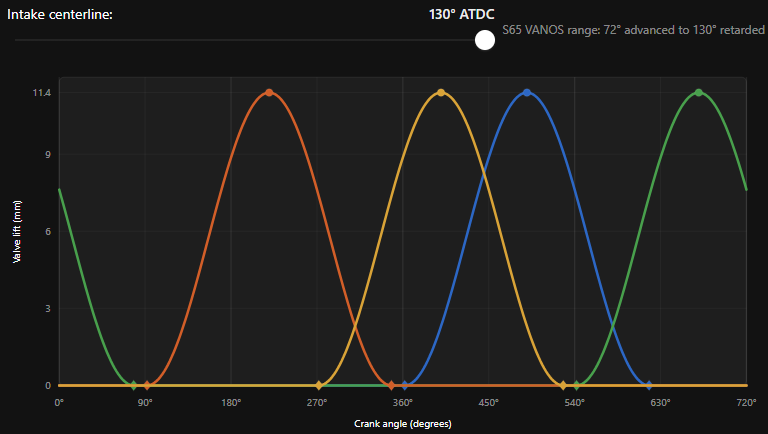
S65 Valve Timing
The reason BMW switched to a double-roller system on the S65 is that the valve-actuation forces from the 4 cylinders per cam are more transient. The S65 cam lobes have, at best, a more distinct separation and a complete separation between Cyl 4 VCE and Cyl 2 VOE as a result of its cross-plane crank/90-degree firing order, placing the Cyl 1 combustion event immediately after Cyl 3. Check out this graph- it's easier to see this way. (This is a very generic cam profile for the sake of timing clarity)
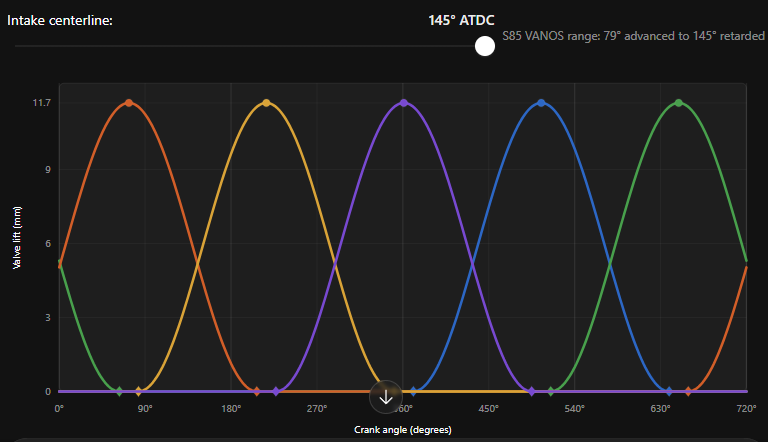
 S85 Valve Timing
The S85, on the other hand, with 5 cylinders on each bank, with one cylinder (per bank) firing every 144 degrees of crank rotation, has a perfectly even cam event spacing (in terms of degrees of rotation) with significant overlap between cam lobes.
Graph attached below here too)
 How does this matter?
This difference in overlap (per cam, not per cylinder) is why the single-row timing chains were sufficient for the S85, but not for the S65. Attached below is a chart showing intake cam torque load (in brown) and the torque load for each cam lobe pair in Blue, Red, Green, Yellow, and Purple for the S85 at 3000 RPM- most of the miles on these motors will occur in this regime. As such, life expectancies based on cyclic fatigue and frictional wear would likely be calculated here.
(This is an approximation with accurate weights, spring forces, and approximate cam profiles, for the purpose of illustrating the point. This is not an exact model that should be referenced or treated as real-world 1:1 data points.)
S85 Bank 1 Intake Cam Torque Loading Chart
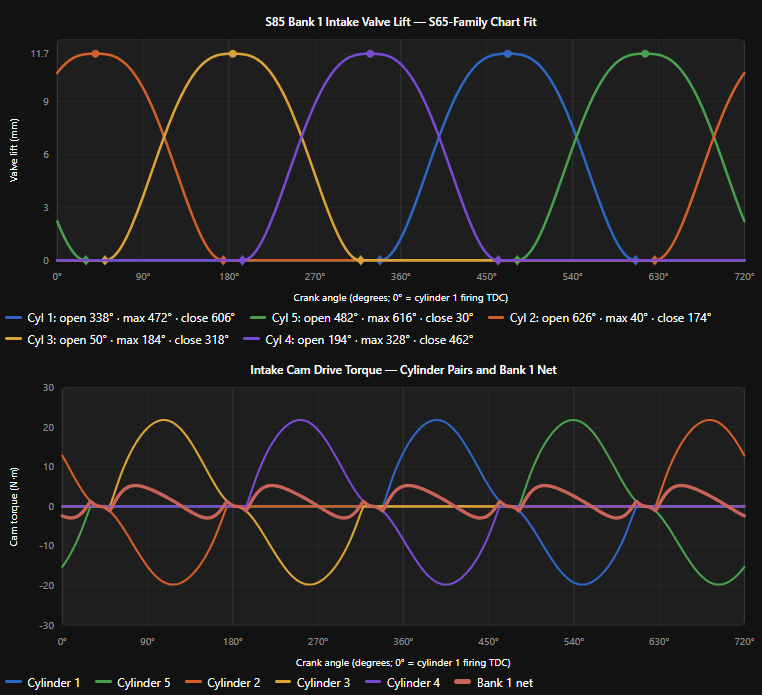
Now compare that to the torque load of the S65 intake cam. Notice how there are significant dead zones where no torque is being applied and other areas where torque peaks to the full force of an individual pair of cam lobes- 21.9 newton meters of torque at 3000 RPM. The S65's timing chain must transmit more than 4 times as much torque per cam as the S85's timing chain does at 3000 RPM.
- Down at 1500 RPM, the S65 cam torque load is up to 23 Nm, and the S85 is down to 2.2 Nm.
- As RPM increases, the gap does close- at 5,000 RPM, the S65 will see a peak of 23.9 Nm, while the S85 sees a modest 13 NM; the gap has closed to a little under 2x.
- By 8250 RPM, there is significant parity in peak torque load (S65: 39.3 Nm, S85: 33.8), but a high degree of transience from full load to zero load on the S65 cam, while the S85 has a consistently repetitive load cycle per cylinder.
S65 Bank 1 Intake Cam Torque Loading Chart
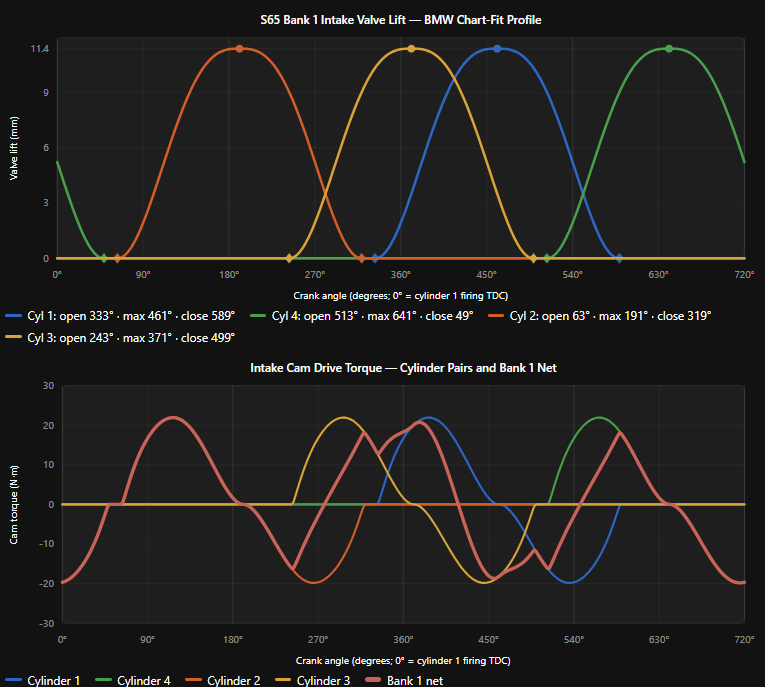
The reason the relative difference decreases with increased RPM is the result of increasing inertial loads, as the valve velocities and rate of acceleration both increase significantly from 48.93 newtons at 1500 RPM to 1436 newtons at 8250 RPM. As the inertial load becomes the dominant force component the timing chain must overcome, the peaks will start to normalize to each other due to similarities in the valvetrains' mass.
Having said all of that, let's put this into perspective: We can also simulate exhaust cam timing and loads and see that the peak combined cam torque load is 64.3 Nm. The
S85 Timing chain is a 06B-1 (simplex) chain- this chain has a maximum working capacity of 1900 N of tensile load. That is a 50% safety margin. Before you consider that the S65 has twice that working load.
Total Cam torque load per bank
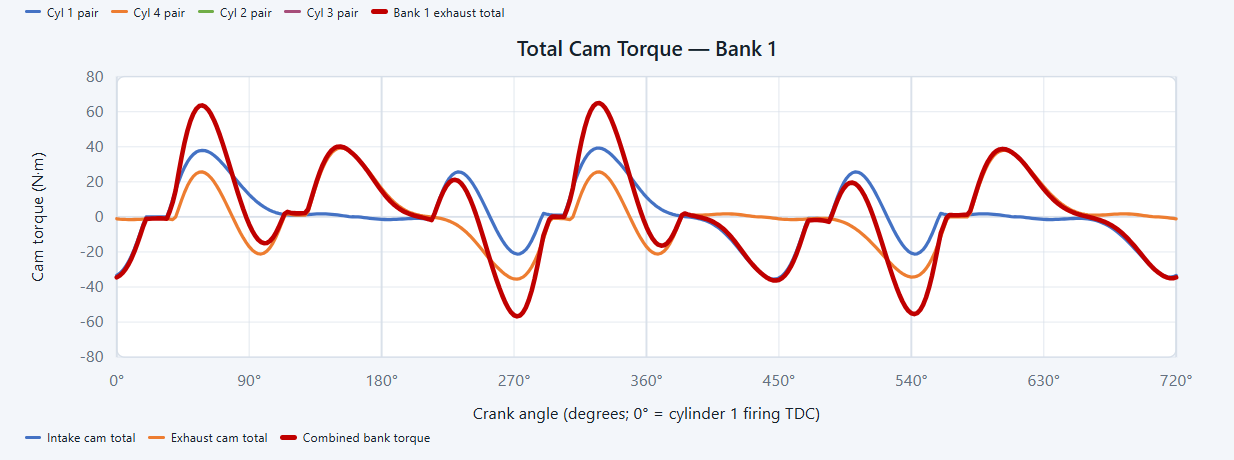 Total System Torque
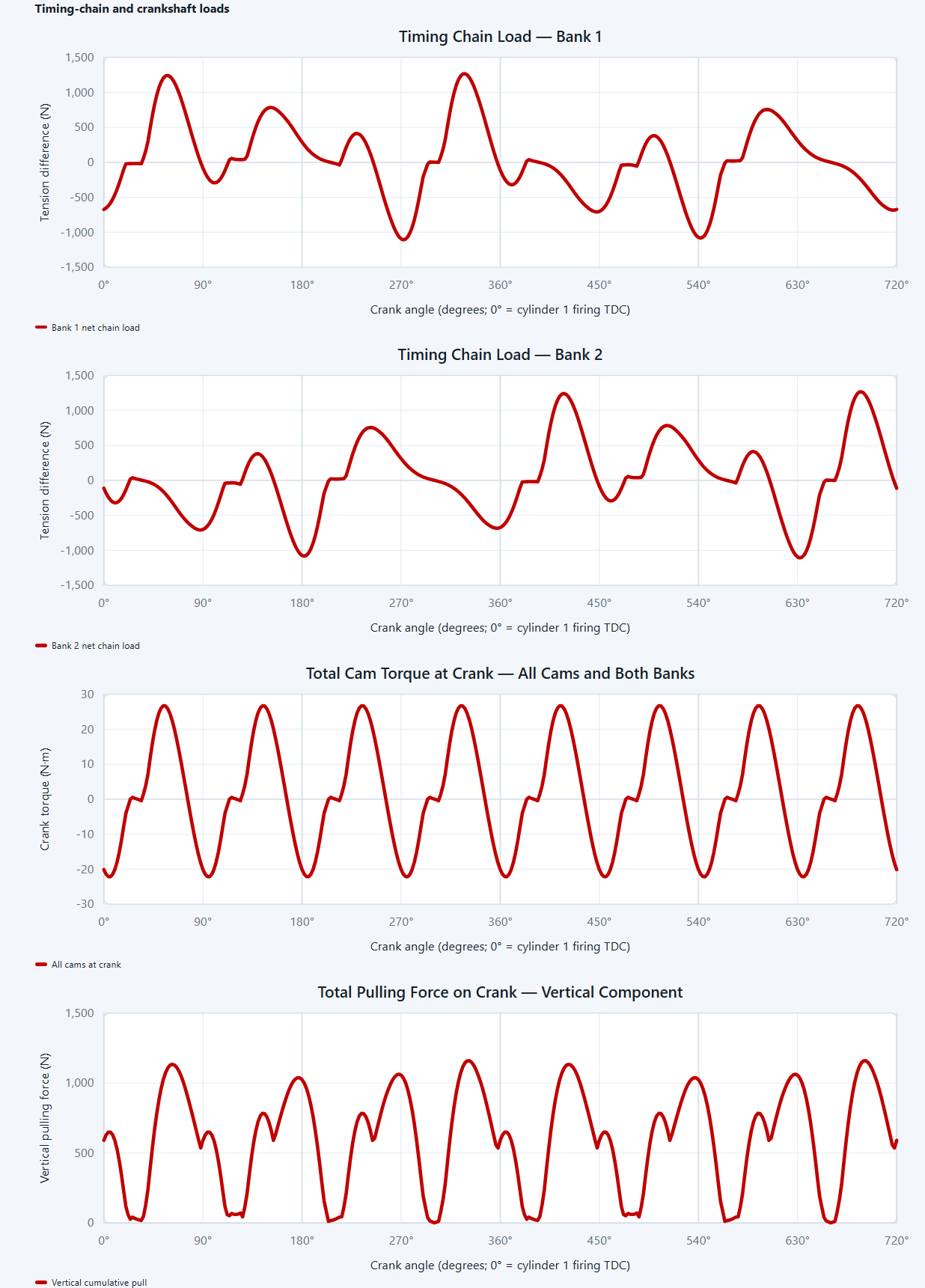
This means there is a peak chain load of 1255 Nm per bank, and I hear you thinking "that means 2500 Nm of total force on the crank!" and It's reasonable to think so, but because the peaks are 90 degrees out of phase, each bank's peak forces are never going to affect the crank at the same time
Total System Torque
This means there is a peak chain load of 1255 Nm per bank, and I hear you thinking "that means 2500 Nm of total force on the crank!" and It's reasonable to think so, but because the peaks are 90 degrees out of phase, each bank's peak forces are never going to affect the crank at the same time.
S65 Chain loads and Cam Torque at Crankshaft
 Allow me to explain:
So, what are the actual peak forces the crank will experience, since that is what we are talking about, after all..
Because the crank spins twice for every one cam revolution, and therefore, has a sprocket diameter 1/2 that of the cam sprocket, it takes half the torque to generate the requisite force on the chain. But, as ever, there is more nuance than that, so it is not simply 1/2 the total cam torque. This is because, as I mentioned previously, each bank is 90* out of phase relative to each other. So.... I plotted this out too.
Peak torque at the crank is 27.3 Nm, which, if all of the torque were going straight up (it is not), would result in a maximum pulling force of 1065 newtons... But there is more nuance than that too- simply using peak torque at the crank assumes there is no negative torque being applied to the crank (this happens during valve closing events), and that matters because ANY torque, positive or negative (relative to the crank), requires a tensile load on the chain, which is by definition a pulling force.
Once all of this is considered and factored into the model, it is a (somewhat) accurate representation of the forces the crank will experience during operation, even under the worst-case scenarios.
So, the peak vertical force the crank sprocket will experience (all tensile forces considered) is 1133 Newtons or 254 pounds of force.
Add to that the additional upward force from the oil pump gear
85 N, the pulling forces of the chain tensioners (85N spring preload, plus oil pressure (.55 sq. cm piston, 5.5 Bar oil pressure (high estimate, peak oil pressure), and approximately 1.5 leverage on the tensioning guide. Approximately 180 N of force per bank) multiplied by the leverage of pushing perpendicular to the length of the chain at a low deflection angle, resulting in a chain tension of 347 N. This has to be multiplied by 2x because the chain is a loop, so the real tensile force of each chain is 694 Newtons. A little bit of trigonometry will show that the net vertical force on the crank is approximately 1146 newtons (257lbs.).
To finally mercifully, get to the point:
(All of the following numbers are calculated at 8250 RPM)
Based on all of that, we can reasonably assume that the total upward force on the crank is created by:
- Peak torque required to drive the cams: 1133 N (Mean torque is 603.7N)
- The deflection of the geared oil pump drive: 85 N
- The tension created by the timing chain tensioning loop: 1146 N
Amounts to an estimated total of 2364 Newtons of upward force on the crank. (532 lbf)
As I mentioned in the video, Hydrodynamic lubrication generates OBSCENE force resistance values. A properly formed wedge in 60-weight oil will have a force resistance in excess of 28,000 PSI perpendicular to the direction of the force. The S65 main bearings, top and bottom, both have more than a square inch of surface area (the bottom has FAR more).
There is not a chance that the 532 lb. of force on the nose of the crank is sufficient, on its own, to cause the front main bearing to fail. BMW did not switch to a Double roller chain because the forces on the timing chain are so immense; they did it to extend the service life of a part that, if it were to ever wear and fail, would cause catastrophic failure to a point where it is a non-issue.
This upward force is, however, a symptomatic component of the failure mode. The two most important factors for hydrodynamic lubrication performance are the volume of oil flow and the oil temperature at the highest pressure in the wedge.
If flow volume breaks down, the oil temperature in that high-pressure zone goes through the roof, the oil loses its lubricating properties, and metal-to-metal contact occurs.
If you also have 500 lbs pulling up on the nose of the crankshaft while the wedge is barely performing, it only makes sense that you would see severe wear on the top of the front main bearing, especially since the oil pressure falls through the floor at low load/transient throttle, not when the crank is absorbing all 1855 lbf of rod force from BMEP ( that is the mean force throughout the power stroke- peak rod force is well over 8000 lbf that is more than 4000 lbf per main bearing, and a full 8000 lbf through each rod bearing (35,500 Newtons), but we are all concerned about the timing chain tension because its a couple inches in front of the front main.)
I do not believe that oil flow to the front main ever goes to zero (under normal operating conditions); if it did, the front main would seize and spin within a second, and we would not still be talking about this in the big ‘26. What I believe is happening is that oil flow is dropping low enough that (in the front main in particular) the bearing operates on the ragged edge of starving for oil, thus resulting in the front main bearing dying a death of a thousand paper cuts. Each time it happens, the bearing profile gets slightly worse, and performance goes down just a little more, until eventually you destroy your crankshaft and your block, so you have to pay a $5000 core charge in addition to buying a new motor. If you don't decide to scrap the car or toss a junkyard motor into it to do it all over again.
Even worse, when you oversize your rod bearings thinking you're being a safe and responsible owner (just like, quite literally, every single one of our S65 customers), the front main seizes at ~20k miles almost every single time. Hashtag: Tragic.
former 240 s14 wrote 27% more volume, did I hear that right. That mixed with the SRD gears sounds like the way to go versus a dry sump, assuming the pump isn't $10k.
Very excited to learn more about this and appreciate the efforts Chris and Partee are making for our community!
Rubin
27-point-something percent is the joke around here, lol. But yes, that is accurate. Between this and the SRD upgrade, oil flow capacity is increased by 90%. Without meaningfully increasing peak oil pressures beyond 80 PSI or wasting a ton of energy by bypassing excess oil. It simply pumps as much oil as the motor needs at any given volume demand. This might actually pair perfectly with your accusump idea. Although, you will not need it.
We are targeting 2200 or less. Sourcing the internal components is mind-bendingly expensive, but still beats the hell out of new OEM pricing.


 former 240 s14 requested more details on our upcoming high-flow oil pump.