 |
|
 |

|
|
|
| 03-10-2026, 02:18 PM | #23 | ||
|
S.FL S65 Specialist
4545
Rep 4,341
Posts |
Quote:
This makes your point less impactful imo. "the amount of decrease is between 2-3 PSI, over a 70+ PSI average. Assuming the 73 PSI average, a 3 PSI pressure drop is equal to 4% of the total. Whether it was the 5%, 30%, or 50% throttle input, the results were all the same: a 2-3 PSI drop over a 73 PSI average. This is proof positive that the S65 variable displacement oil pump is doing its job." BE summary below, copied from the thread linked above. Why can't someone produce similar data to prove their theory? Esp when claiming to fix the problem and are selling a solution. Quote:
__________________
Last edited by tdott; 03-10-2026 at 02:24 PM.. |
||
|
Appreciate
3
|
| 03-10-2026, 02:20 PM | #24 | |
|
Field Marshal

10036
Rep 2,641
Posts |
Quote:
__________________
'08 E92 M3 DCT Melbourne Red/Bamboo Beige Leather/EDC/SSP Spec-R DCT clutch/SSP Pro-Gold DCT Fluid/Quaife LSD/3:45 Final Drive/BE Bearings & ARP Bolts/LUX H8 180/DCT Tune by BPM Sport/PFC Z-Rated Pads/ECS Brass Brake Caliper Guides/Alex Shop Solid Sub-frame Bushings/Motul 600/Tint
|
|
|
Appreciate
1
///M Power-Belgium92183.50 |
| 03-10-2026, 02:29 PM | #25 | |
|
BimmerPost Supporting Vendor

92
Rep 23
Posts  |
Quote:
|
|
| 03-10-2026, 02:29 PM | #26 | |
|
S.FL S65 Specialist
4545
Rep 4,341
Posts |
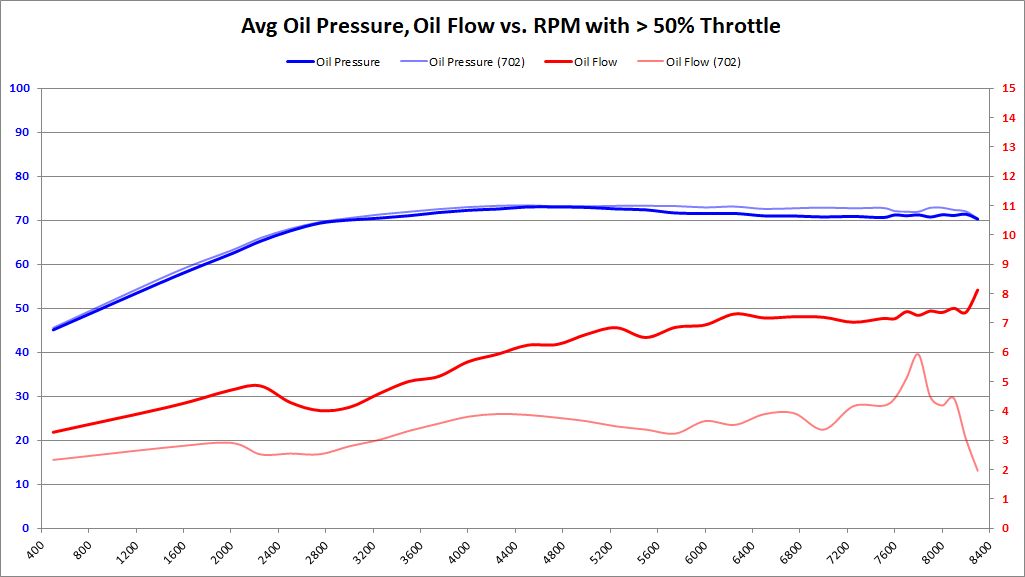
Also is there not a pressure relief valve in the oil system? Looking at the BE oil pressure vs RPM graph, it flattens from ~3800-8400rpm.
If so, wouldn't over driving the oil pump make it work harder for no reason? Otherwise pressure would continue to always build with RPM. The difference in oil pressure someone else measures could just be due to their equipment, or sample location. Quote:
"Having double oil flow over the bearing surface increases the wedge strength and keeps the bearings cooler. " |
|
|
Appreciate
1
DrFerry10035.50 |
| 03-10-2026, 02:47 PM | #27 | |
|
S.FL S65 Specialist
4545
Rep 4,341
Posts |
Just throwing some AI answers out there to provide general info on oil systems in the motor. I'm no automotive engineer, nor are there technical details published on the S65 oil system, so I take some of these as general assumptions assuming they are valid.
Quote:
|
|
|
Appreciate
2
DrFerry10035.50 SYT_Shadow12759.50 |
| 03-10-2026, 03:14 PM | #28 |
|
BimmerPost Supporting Vendor
92
Rep 23
Posts |
Just to be super clear: This is all open for serious debate and analysis. As engine builders, however, we have to be prophylactic and risk-averse. So when we see nearly 100% of the blown S65s coming our way with rod bearings with greater than stock clearance, we feel compelled to address it as we have. Just wanted to share that with the group. Do with it as you please!
--Peter |
| 03-10-2026, 03:53 PM | #29 |
|
Field Marshal
10036
Rep 2,641
Posts |
Quoted from the link below which is packed with test results and in great depth information on this topic.
https://www.m3post.com/forums/showthread.php?t=1337998 "But the resulting oil flow is nearly double with BE Bearings over the BMW 702/703 bearing counterparts. Having double oil flow over the bearing surface increases the wedge strength and keeps the bearings cooler. The results with BE Bearings seems to be a huge win, much bigger than any of us expected."
__________________
'08 E92 M3 DCT Melbourne Red/Bamboo Beige Leather/EDC/SSP Spec-R DCT clutch/SSP Pro-Gold DCT Fluid/Quaife LSD/3:45 Final Drive/BE Bearings & ARP Bolts/LUX H8 180/DCT Tune by BPM Sport/PFC Z-Rated Pads/ECS Brass Brake Caliper Guides/Alex Shop Solid Sub-frame Bushings/Motul 600/Tint
|
|
Appreciate
1
///M Power-Belgium92183.50 |
| 03-10-2026, 04:04 PM | #30 | |
|
Field Marshal
10036
Rep 2,641
Posts |
Quote:
__________________
'08 E92 M3 DCT Melbourne Red/Bamboo Beige Leather/EDC/SSP Spec-R DCT clutch/SSP Pro-Gold DCT Fluid/Quaife LSD/3:45 Final Drive/BE Bearings & ARP Bolts/LUX H8 180/DCT Tune by BPM Sport/PFC Z-Rated Pads/ECS Brass Brake Caliper Guides/Alex Shop Solid Sub-frame Bushings/Motul 600/Tint
|
|
|
Appreciate
3
|
| 03-10-2026, 04:47 PM | #31 | |
|
Second Lieutenant
381
Rep 274
Posts |
Quote:
Do you know what other variables were at play with the engines you’ve serviced? I’m not knocking changing oil pump gears, I just want to learn more. |
|
|
Appreciate
1
DrFerry10035.50 |
| 03-10-2026, 05:15 PM | #32 | |
|
BimmerPost Supporting Vendor
92
Rep 23
Posts |
Quote:
But there is no way to draw any overarching conclusion even from a couple years' worth of sampling the engines we see. The chance of a skewed population is WAY too high for that. But the SRD gears DO increase oil pressure and, thus, by our lights, are a good precautionary measure at the very least. --Peter |
|
|
Appreciate
3
|
| 03-11-2026, 02:05 AM | #33 | |
|
Private First Class
 
475
Rep 194
Posts |
Edit: In the interest of clarity and at Robert's request, shortly after making this post, Robert Collins, the owner of BE bearings, reached out to Peter to let him know he was frustrated with me over this post. Peter told Robert to call me to discuss it and said he trusted my assessment. I reached out to Robert via Social Media to discuss. We chatted a little bit, where he informed me that he had updated the graphs to include the OEM startup RPM (in addition to OEM pressure) with the BE startup graphs. I will share screenshots of those for transparency on the next page.
Partee Racing LLC Peter, I might be late coming in tomorrow, lol. This will be high effort As Peter said, we intend to throw no shade at all at BE with what we're saying here- We think they offer an excellent product, a necessary[/B] product, and did solid due diligence in researching their product before releasing it to the general public. However, I cannot advise treating their article (linked immediately below and further referenced in this comment) as a peer-reviewed proof. They draw some unfounded and concerning conclusions throughout the article, which led me to doubt the study's validity entirely. Link to referenced article https://www.wiki-diy.com/index.php/O...Flow_Analysis? The first thing that raised my eyebrow was the section where they referenced oil flow: The fact that oil flow never gets above 2.5 GPM until the motor reaches 100 °C, then has a roughly 300% increase in flow from 98 °C to 103 °C and a 600% increase in flow from 98 °C to 109 °C tells me that the sensor (Flow Tech, see the next image) was mounted between the oil thermostat and the oil cooler. This placement is H I H G L Y problematic- Placing the flow sensor between the oil cooler and the thermostat is problematic because, even when the oil is above operating temperature and the thermostat is fully open, a percentage of the oil can still bypass the oil cooler as a function of DeltaP between the two routes of flow- the oil cooler is a restriction on the system, as is the fully engaged thermostat. Pressure is a function of flow and restriction. More on that later. This creates a multi-dynamic scenario in which one of your key data points is influenced by more than the single variable you are testing. In this case, the flow measured is influenced not only by the intentional change you are making, but also by the secondary effects your change has on the flow rates of the thermostatic bypass and the oil cooler, which will not necessarily be affected 1:1. There are a handful of easy workarounds for this that they chose not to do, either because they did not think it would matter, or because they were unaware of this issue. Either case is cause for concern IMO. Then, I saw their claims about the time to pressure being significantly shorter This honestly had me baffled- I was lost at how this could be possible. Maybe because the reduced restriction allowed any air in the system to escape that bit faster? doubtful. Maybe because the theoretically increased flow allowed the pressure to get to the bearings faster? I don't think that's how it works in a system like this- the pump is going to move a specific volume below its relief pressure. That line of logic led me to the smoking gun. RPM. I am going to have a lot of screenshots of their graphs here; bear with me while I try to illustrate what I noticed. 0-10 °C BE 1.9 seconds to 90% pressure, OEM 2.6 seconds to 90% pressure. BE: OEM: Do you see it? Why did they leave out start up RPM from the OE bearing test? Also take note of the pressure dip at ~3 seconds... That is a VANOS sweep... that will be important later. How about now? The 2nd capture is after I scaled the RPM axis to match BE, so you could also see the difference in peak RPM without it being different for no apparent reason. Why would they overlay the OEM time to pressure in their direct comparison, but not the OEM RPM log as well? I think if they had, they would have seen where the faster time to pressure came from- not the bearings, but the different startup profile- possibly from a tune? These things matter. Here are the rest for consideration of my overarching point- BE does solid work, they offer a great product, but this study is deeply flawed. In the image above, you'll note that I added the individual second scale to the horizontal axis because the OEM bearings were marked on every fifth number, and the BE bearings had every second marked. After I verified that the scales matched in distance but not in granularity, I aligned them for an apples-to-apples comparison. You'll notice the OEM logs all hit peak RPM later than the BE logs, and that, with the exception of the 30-40 °C run, the OEM logs show a lower peak RPM. Again, pressure is a function of Restriction and flow volume. Flow volume is a function of pump RPM (below bypass pressure). Pump RPM is a function of Engine RPM. It is quite obvious then, that their conclusion that the BE bearings caused the decrease in time to pressure is entirely false: Quote:
More concerning, if they did tune the car in between these tests without realizing it would make a difference, what else was changed? Did they change the oil cooler? That would have a profound impact on the measured flow in their arrangement. Moving on to measured oil pressures at given temperatures- Mostly no notes. Except for a few. These are WAY different. like... from different tests altogether, it stands out so much; not just different from each other, but also different in a way that makes no sense at all. Also, why are these two graphs the only graphs that measure anything >5% throttle? you could theoretically get wildly different data for the same parameters without being outside the rules of this chart- one chart could be nothing but slow builds to redline at a steady state 20-50% throttle, the other could be WOT rips. We need live throttle data in these charts to make sense of them, not just "greater than 50%" as the tightest throttle constraint. Fun fact- VANOS maps are RPM X Torque Request. Remember earlier when I said you should take note of the dip in oil pressure at the ~3-second mark on all those cold start logs because it is a VANOS sweep? This is where it matters. Also of note- that dip is a fairly lazy vanos sweep. IIRC, the VANOS System can independently sweep each cam at up to 360 degrees per second. This consumes a significant amount of oil volume while the VANOS target is changing rapidly, which occurs much more in the mid-throttle, 5-7000 RPM range. As I said above, VANOS target is based on RPM X Throttle %- this means while in the mid-range RPM and modulating the throttle as you would in a corner at speed, VANOS is having a disco party lol, and RAPIDLY consuming oil volume in the process, potentially tanking oil pressure- I think this is why we see such a noisy plot in the referenced tables. Also of note, during WOT, VANOS is relatively steady state, making only slight adjustments as the table traverses the RPM range- Matt, our in-house tuner, showed me the tables a few months ago, and the amount of change in the midrange legitimately blew my mind, especially compared to just how little change was happening under WOT. I cannot make sense of this either: how is it that you have both increased the volume quite significantly (we've covered why that claim is not necessarily supported) AND you've significantly increased Oil pressure in the 108-109 °C range? It is a fact that you've increased clearances, thus reducing restriction, which would theoretically increase flow volume at the same oil pressure, but how is it that oil pressures are RISING when the oil is at its least viscous? The only thing I can think of is a lack of data points for this specific range and/or an error in data compilation. Finally, the claim that you have doubled oil flow volume while only losing 3PSI overall is just the result of bad data from a bad sampling point- I am sure you did increase volume throughput by increasing the clearances, and that is good for the rod bearings, but any PSI drop across the systemis going to be catastrophic to the mains due to their already sub-optimal geometries. Which is what we are seeing across the board in the real world. We've pulled apart 150k-mile S65s with stock rod bearings- the RBs are always in bad shape, but the mains are typically in much better shape than lower-mile motors that are in for rebuild, only to discover that the block and crank are both trash because the #1 main spun, and the rest of the mains look TERRIBLE. We're talking dozens of S65s that all tell the same story. Here's the thing- going from a clearance of .0006" (minimum spec for early S65s IIRC) to .0022", which is what BE is IIRC (that's what the SRD paper cited), then you reduce the resistance of the slot (bearing clearance) by as much as 98%- that is a greater than 49x increase in potential conductance! Now, obviously, that number comes from making some simplifying assumptions and ignores all the dynamics going on in the journal, but the fact remains: you've effectively taken the cap off the main bearing and reduced one of its key downstream restrictions to basically fuck all. As BE pointed out, flow volume is the key to good wedge formation- that is why on all of these S65s weve gotten with spun main bearings, the rod bearings are PRISTINE (except for the rods affected by the welded-closed main bearing feed inlet) those rod bearings are getting 80-90% of the flow that is meant to be shared between the mains and rods. By opening up the rod bearing clearances and leaving the main bearings as OEM, you are creating a wildly imbalanced system. As Peter said- at least spend the extra $400 on the overdrive kit to get more flow through the mains too! AutoTalent- I want to reiterate, my goal here is not at all to insult you or BE- we genuinely appreciate what you all have done for the community, and it is obvious that you put a lot of time and effort into documenting your findings, AND that you made a huge effort to be entirely transparent in the process. I respect the hell out of that, and if at any point I've sounded like I was attempting to call your integrity into question, I hope you know that is not my goal, nor is it what I think. This is the peer review process. I have been on the business end of this more than once, and it is not an enjoyable place to be. It is quite easy to go through someone else's work and find all the flaws. It is another thing entirely to do the work and create information for your peers to pick apart. This is all in the effort of finding the best answer for the community. I hope you can understand that. We have nothing to sell here- we buy BE bearings, and we buy SRD gears because we believe in both products. Peter would never allow us to use anything we do not believe is the best product we can source. Moving on- here is what I am still trying to work out: The oil pump is a variable displacement rotary vane pump. It has no electronic controls whatsoever. I had one of these $3000 pumps apart last week, and I had another open several months ago (sorry Peter lol, I promise I put them back together properly). Ive been digging into them because I cannot wrap my head around the oil pressure behaviors I see in the datalogs. What I know- the pump has two methods of bypassing excess volume, both based on pressure. Primarily, it uses variable geometry to reduce flow, thereby reducing pressure as a function of flow. Secondly, it uses a traditional bypass valve set to a higher pressure. What doesn't make sense, though, is that if the pump is flowing more than enough oil to achieve the requisite pressure after X RPM, then the pressure should not drop off after it reaches the bypass pressure- this should happen smoothly as well, because of the variable displacement functionality. It should reach the target pressure, as dictated by the spring, and stay there. Period. As VANOS consumes oil, the system should react nearly instantaneously to that increased volume demand- the 20 PSI swings we see in the chart below simply do not make sense in this situation. Dips and bumps, sure, but not such massive swings in pressure as seen below: What we suspect to be happening is that the oil pump is insufficient in stock form- this makes sense if you think about BMW's design goals in the early 2000s, when oil prices were at all-time highs- maximize performance, minimize fuel consumption. Maybe they thought that cars getting 20 mpg on the highway instead of 19 would sell 20% more cars, so they reduced drag wherever they could in the name of performance and efficiency. So they engineered a pump that was juuuuuuust right for the stock clearances. Then we opened up the bearing clearances because thats what worked of the E46. Oof. If the pump is NOT riding on the bypass spring much at all, which I doubt it is, then these variances would make a lot more sense. I cannot imagine that the pump is bypassing much at all at 70 PSI while flowing over 13GPM, if it's able to build 85 PSI at 40-60 °C at ~3kRPM and only flowing 8-9 GPM. The bypass will bypass at a specific PSI- temperature or oil viscosity be damned. There needs to be sufficient pressure on the spring to move it. That pressure is a function of restriction and volume. At low temperatures, there is sufficient restriction (because of the significantly higher viscosity) to generate enough pressure at the volume of flow the pump is capable of producing to hit the bypass threshold. In all other times, it appears that this is not the case- even in stock form. Increasing clearances without increasing the pump flow rate will only exacerbate this. This is a solid article on the functionality of a variable displacement pump if anyone is curious- although this one has an electronic control solenoid that allows it to be switched between high and low pressure- notice how locked in it is at its set pressure (although you have to be aware that this is a far less dynamic situation than an engine) Performance_prediction_and_experimental_study_of_v (1).pdf As AutoTalent said- testing equipment is expensive- the Flow Technologies turbine was $1000, and they bought it to attempt to gather more useful data. Hats off to them for their commitment. We just spent $60,000 upgrading and redesigning our engine dyno (in addition to the initial $50,000 up front cost from SuperFlow) for the same damn reason. We want nothing but absolutely conclusive data on everything we do and every product we support. Anything less is insufficient.
__________________
General Manager
Head of Engineering and Design  Last edited by Chrisyphus; 04-20-2026 at 08:11 PM.. Reason: Updated info. |
|
|
Appreciate
6
|
| 03-11-2026, 02:11 AM | #34 | |
|
Private First Class
475
Rep 194
Posts |
Quote:
Is a baffled oil pan a bad thing? No. Absolutely cannot hurt. We just aren't convinced it will fix the real problem- insufficient oil volume from the pump.
__________________
General Manager
Head of Engineering and Design |
|
|
Appreciate
4
|
| 03-11-2026, 02:28 AM | #35 | ||||
|
Private First Class
475
Rep 194
Posts |
Quote:
Stock high-mile motors (150k) coming in with rod bearings about to have a Disco Party, and main bearings showing moderate wear. Vs. Low-mile motors with replaced rod bearings, coming in with the front main welded to the crank and the rest of the mains in TERRIBLE condition, while all of the rod bearings look brand new despite their 10-30,000-mile life in the motor. I go into more detail on why this appears to be happening (based on math and theory, until we do more testing) in my first response ITT. Quote:
Quote:
It is obvious that Peter meant flow here- sharp shooting that is weaponized pedantry and is beneath this discussion, especially from two forum members I respect.
__________________
General Manager
Head of Engineering and Design |
||||
|
Appreciate
3
|
| 03-11-2026, 02:36 AM | #36 | |
|
Private First Class
475
Rep 194
Posts |
Quote:
The main bearing is fed enough oil for itself and the rod bearing. As I mentioned in my first response to this thread, increasing the clearance of the BE bearings from an early-gen S65 results in a net decrease in rod-bearing restriction of up to 98%. This means that one of the primary restrictions for the main bearing's oil flow is effectively removed. Whereas the main was originally probably supposed to receive 55-60% of the oil volume going to it, it could now be receiving as little as 10-20% of the flow, despite being fed from an oil galley with 70 PSI.
__________________
General Manager
Head of Engineering and Design |
|
|
Appreciate
4
|
| 03-11-2026, 02:41 AM | #37 | |
|
Private First Class
475
Rep 194
Posts |
Quote:
Realistically, the BE clearances are optimal. It just seems to us that the oil pump is incapable of keeping up with the increased oil flow demands.
__________________
General Manager
Head of Engineering and Design |
|
|
Appreciate
1
mainuser2.50 |
| 03-11-2026, 02:55 AM | #38 | |
|
Private First Class
475
Rep 194
Posts |
Quote:
__________________
General Manager
Head of Engineering and Design |
|
| 03-11-2026, 03:05 AM | #39 | ||
|
Private First Class
475
Rep 194
Posts |
Quote:
Bruh. The chatbot specifically referenced the effect of the elevation of the cylinder heads as a source of pressure drop, lmao, as if the head pressure of 24 inches of water column is more than a single PSI. (it's less.) Oil pressure sensors are always placed near the outlet of the pump/ before the oil demands. Placing it anywhere else would not only be more challenging in this case but also beyond foolish.
__________________
General Manager
Head of Engineering and Design |
||
|
Appreciate
1
IamFODI609.50 |
| 03-11-2026, 07:25 AM | #40 | |
|
BimmerPost Supporting Vendor
92
Rep 23
Posts |
Quote:
To be clear about what we are seeing in the flood of S65 rebuilds this year: Contrast: (1) High mileage S65s with original stock rod bearings or replaced stock bearings with stock clearances: Rod bearings in near disaster condition, but mains intact With (2) S65s with replaced bearings and wider clearances: No. 1 main bearing welded to crank, but rod bearings are fine, save for those that have been affected by the No. 1 main bearing. We also have yet to see an S65 with a Dailey dry sump fail as a result of a No. 1 main bearing or rod bearing failure. Yes, this is just our sampling, which one can argue is inherently skewed because engines come to us only when they need to be rebuilt. And there are other explanations, such as expansion of the No. 1 main journal as a result of the torquing of the harmonic balancer bolts, that certainly constitute contributing factors to the phenomenon. But as engine builders, we would be remiss if we did not take into account our experience and that of another builder who sees the same volume of S65s albeit in the race context in concluding that oil pressure (i.e., flow) is an issue in the S65 and that issue appears to be exacerbated, frequently to the level of catastrophic failure, when rod bearings with higher clearances are installed. Materiality is in my mind the question. BE's analysis concludes the pressure drop is immaterial. We appreciate the analysis, but question many of its underpinnings as Chris somewhat pathologically describes above (I have to work with that crazy genius!), and conclude from our first hand experience that there is an issue here and one that can be rather easily addressed in street motors by installing the SRD gears and in race cars by installing a Dailey dry sump. Note that as Chris hints, we may develop an alternative internal gear seat for the S65 oil pump that would address the situation more comprehensively. --Peter |
|
|
Appreciate
4
|
| 03-11-2026, 07:31 AM | #41 | |
|
BimmerPost Supporting Vendor
92
Rep 23
Posts |
Quote:
And the No. 1 main bearing is a different kettle of fish altogether, requiring at least .003" of clearance. --Peter |
|
|
Appreciate
2
GeorgeH45.50 former 240 s14558.50 |
| 03-11-2026, 08:47 AM | #42 | |
|
S.FL S65 Specialist
4545
Rep 4,341
Posts |
Quote:
 , but I think in general, points are valid to give some insight into oil pressure behaviors in an engine esp to those that are not familiar. , but I think in general, points are valid to give some insight into oil pressure behaviors in an engine esp to those that are not familiar. Looking forward to hearing about some of the data you see on the engines you've built with SRD gears, please do share when you get a chance. |
|
|
Appreciate
1
DrFerry10035.50 |
| 03-11-2026, 09:23 AM | #43 | |
|
Private First Class
475
Rep 194
Posts |
Quote:
We absolutely do intend to spread any and all information we gather- even if we disprove our theory- you all will see all the information we gain. The only skin we have in this game is that we want to know without question what the best course of action is for our clients- if that means telling everyone we were wrong previously, we will do so.
__________________
General Manager
Head of Engineering and Design |
|
|
Appreciate
4
|
| 03-20-2026, 09:54 AM | #44 |
|
Enlisted Member
 
37
Rep 56
Posts |
Chrisyphus I appreciate your contributions along with everyone else's in this forum, just a wealth of information.
A couple of questions for you regarding wider rod bearing clearances. Out of your sample set with failed main bearings, 1.what rod bearings were used and what were the clearances on them? 2. what oil was used? Would oil weight and viscosity have an effect on oil pressure during these disco parties at operating temperatures? Last edited by 03m_plus; 04-08-2026 at 09:11 PM.. |
|
Appreciate
0
|
Post Reply |
| Bookmarks |
| Thread Tools | |
|
|