After reading many of the posts on this thread, and having once driven professionally for over five years (a while back), I thought I'd throw my hat into the ring here. In my experience, unusually high degrees of brake pad taper and premature wear are caused by multiple things, and all of them typically need some degree of mitigation, adjustment, or modifications:
1)
COOL air goes a long, long way to helping all aspects of braking performance and keeping components cooler on track. Brake ducting (which is properly oriented towards the rotor center core) is paramount since the rotor is a vaned air pump moving air radially from center to extremity. Incorrect rotor direction of rotation exacerbates rotor heat build up, because rotors are typically directional i.e. left and rights. The E9X chassis is tight for adding ducting, but solutions exist. Start here:
.
https://www.turnermotorsport.com/p-3...it-bmw-e9x-m3/
.
https://indstyledotcom.wordpress.com...e-motorsports/
.
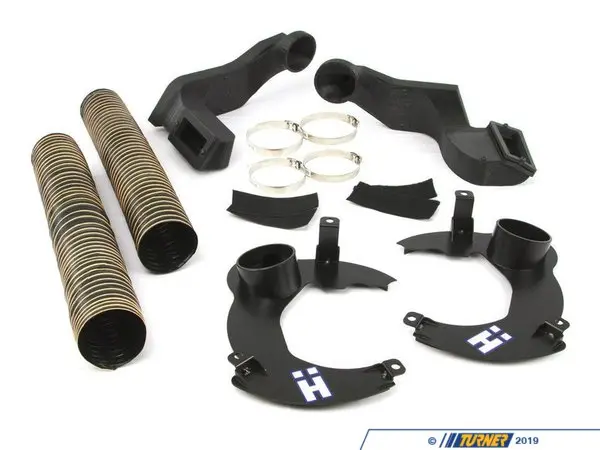
.
2) Unless the track pads being used are of of high quality there's a chance the pad friction material itself may not be a) homogenous or b) bonded uniformly to the substrate backing plate. This is a function of manufacturing quality control and chemical mixing. I can personally recommend the following pad manufacturers: PAGID, Performance Friction, Mintex, and Ferodo.
3) Caliper design is sometimes biased towards lightweight rather than rigidity in order to reduce unsprung weight. However, lightweight calipers not only are typically less rigid but also have lower (less) thermal heat capacity. In other words they get hot quickly even in rear axle positions. Example: A cast iron skillet takes longer to warm up than a thinner and lighter aluminium frying pan. So the caliper materials, its weight, and the design of the caliper can all enhance or detract from its
rigidity thereby leading to "caliper flex" - or not as in the case of say PFC.
4) Wheel bearing float (play) and or soft bushing compliance can cause the suspension geometry to move under dynamic loads. If the hub isn't fixed to suspension arms and links rigidly, the forces seen by the hub (as generated by the caliper and pads) tend to vary and can be affected by escalating temperatures. Heim joints or rose joints as well as solid bushings seek to address suspension compliance but it has been my experience that rigidly mounted calipers and hubs see lower rates of pad taper. I'm not exactly sure of all the mechanisms in play, but if you can afford to reduce hub float and suspension compliance for on track work then I recommend doing it.
5) Caliper piston size and placement play a role in the brake pressure distribution force field 'seen' by the brake pad backing plate. IF the piston sizes are not uniform in a multi piston caliper design, then for any given master cylinder displacement the volume of brake fluid displaced by each piston may not be equal and uniform to all the other larger or smaller caliper pistons. Pressure = Force X Area. So if the area of each piston is not the same then the brake pressure locally seen by the backing plate won't be equal .. will it? Ideally the caliper pistons should be the same size for a uniform pressure distribution field..
I think I'm going to leave it there, but suffice to say the issue is complex and multi-variable. The 1) above is huge so address that one first of all.
.
All hail the King.. Even if the PFC BBK for E9X M3 is dead.. Check out the robustness of its design.
.