Oil Diverter - Initial Write Up
I’ve had an opportunity to drive the Bimmerworld/Epic Motorsports Oil Diverter at two tracks this past weekend—Buttonwillow on Saturday and Willow Springs on Sunday. People who have installed this on older M3’s claim it helps with oil temps. I had not run across anyone who had installed an oil diverter in an E9x M3.
I have a lot of old AIM data at these tracks, so I was curious to see if I could find anything in the data that empirically shows whether or not the oil diverter is doing anything. A big question for me was: are peak oil temps throughout the day more important? Or is the change in oil temp from one hot lap to the next more important? Peak temps didn’t feel as important as the change from lap to lap. For me, keeping the temps under control from one lap to the next seemed more important. That’s what keeps you out there longer, right? I’m no scientist here, but I’m trying to think in a way that ends up being the most useful on track—instead of just some random flashy number of temp reduction.
If I thought looking at temp changes between laps was important, I needed to find at least two consecutive laps from an old AIM session that generally matched two laps I drove on Saturday. So I set out to look for something like that. But I had to be realistic that I am not running a science experiment with all the conditions controlled.
I found an Oct 2018 session that lined up several conditions that I thought were important:
-The air temps were similar: 66ºF on Sat, and 68ºF in Oct 2018
-two consecutive lap times from Saturday were: 1:50.78, 1:50.25. Two consecutive laps from Oct 2018 were: 1:50.70, 1:50.41.
-Both Sat and Oct 2018 were run on Pirelli DH
-Both sessions, the laps were the 2nd and 3rd laps into the session.
However, there was a catch——when I started the car for these two sessions, the oils started at two very different temps (170 vs 206ºF), so that affects things. There are so many variables, it’s just hard to find two sessions that are identical. But regardless, I believe you can still make general conclusions.
What I found in the data was that before the diverter was installed, the change in temps from lap to lap was consistently larger than after it was installed.
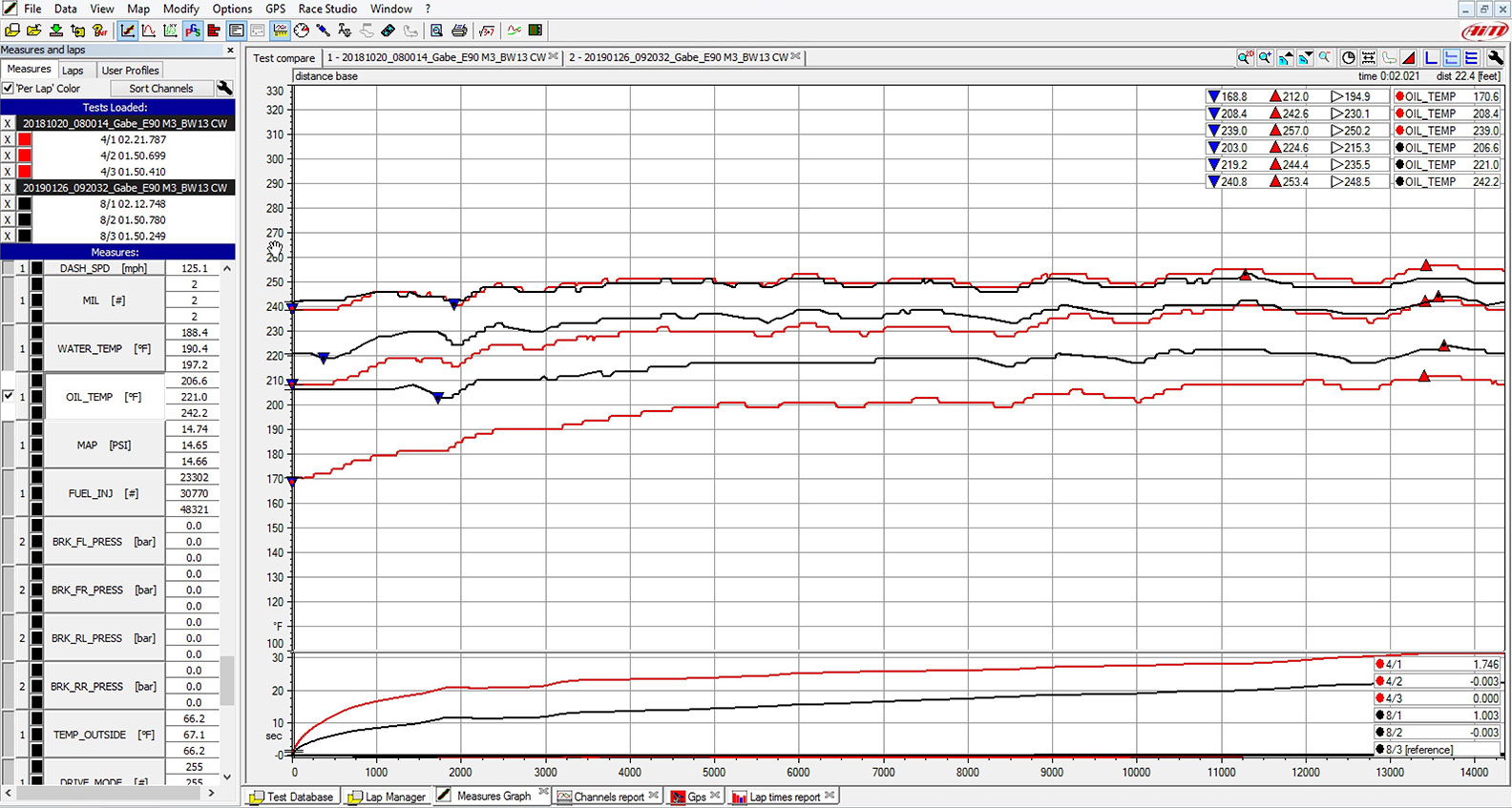
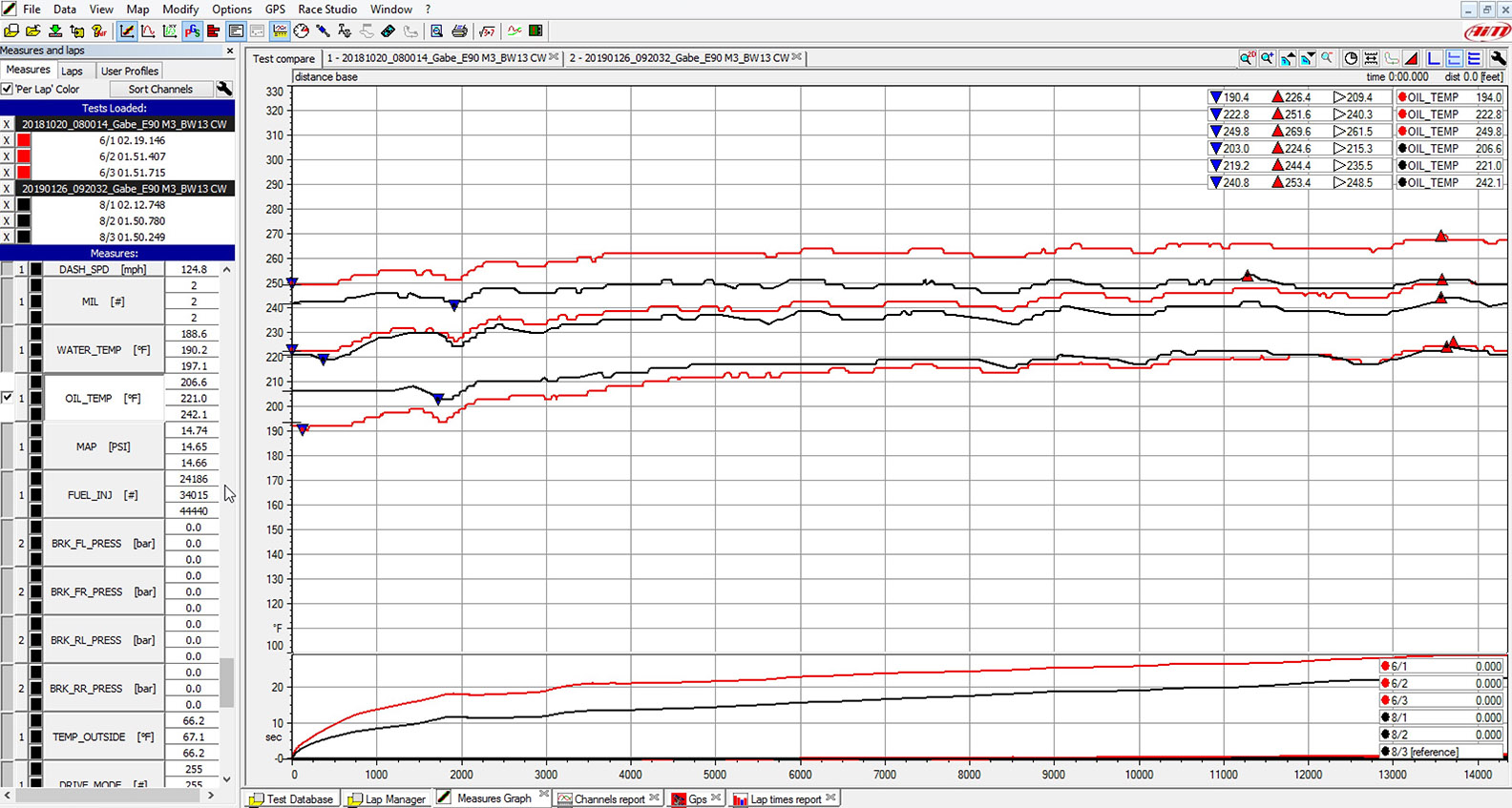
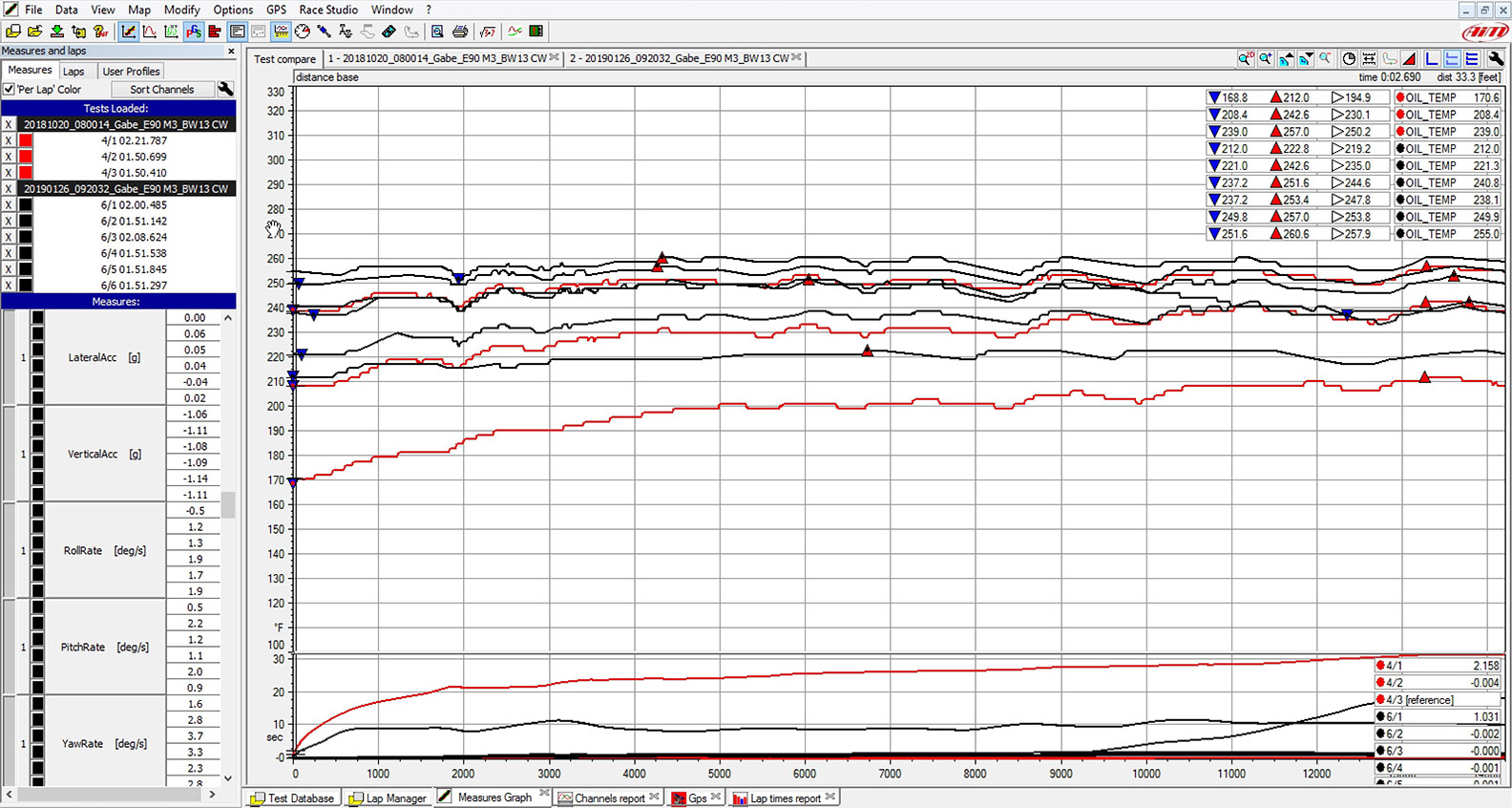
Check out these pics: The lines represent engine oil temps. The black lines are from Saturday with the oil diverter installed. The red lines are older AIM sessions from before the oil diverter. I don’t want to analyze the charts to death because I don’t think they deserve massive scrutiny. But what I DO want to show is how the Black lines are vertically closer to each other than the red lines. This means that the temps are not rising as quickly from lap to lap since the oil diverter has been installed. Since the red lines are always further apart, the oil temps were rising more dramatically from lap to lap.
This first chart is the comparison that I listed above: The Red lines start well below the Black lines, but the jump in temp between each lap is quite large and by the third lap, they are the same. The increases in temps from lap to lap on the Black lines is much smaller.
Here's the same Saturday session compared to a different Oct 2018 session: Again the Red lines jump large gaps---big temp differences per lap compared to the Black lines.
Here's a different Saturday session compared to the first Red session from Oct 2018. And the Black session has a BUNCH of laps. Look how the temps REALLY compress as the temps go higher. It seems as if the car is really fighting off the higher temps pretty well. And the last 3 laps are all 1:51's. I feel like the car used to just keep getting hotter and hotter linearly prior to the oil diverter.
I’m new to this particular data, but I’m taking this new behavior as a good sign. If I'm not reading it correctly, please jump in and educate me.
My initial conclusion: Yes, the data is indicating that, when you look at the change in temps from one lap to the next, the oil is not heating up as much during each lap, and the longer you run, the narrower the temp gap from lap to lap is. Temps seemed to “plateau” at around 260ºF during this first weekend of driving with it. Previously, the oil felt like it would increase in temperature at a more linear rate. After staring at this for some time, I would approximate that I am getting a consistent additional cooling of somewhere around 5-10ºF more cooling per lap of the engine oil with the oil diverter versus the OEM piece (depending on when in the session you look). I think it’s difficult to just look at it and say, “the oil is now XXºF cooler.” There are just so many variables.
If I were to tell you how it felt before looking at any data (oh no——butt-dyno!!), I would say that the oil temp gauge was staying very near the 3/4 “dot” and it was hard to make it go much above that. The car simply felt quite good lap after lap. It felt “ready-to-go” for another lap more than I’m used to.
(There’s a new thread in this sub-forum dedicated to the same oil diverter. Someone posted that they are seeing a 17ºF difference with the diverter installed. My question is, 17ºF compared to what? The max of some other day? Were the air temps the same? How many laps were run? All these things play a big role in oil temps.)
Anyway, I need to drive it more. But I was pleased with what I was feeling in the driver's seat, and the data seems to confirm what I was sensing. I'm eager to put in some more laps!!