Originally, I was going to just post a couple pix of data about my new OS Giken diff and add a couple notes. But then I got into the typing and I thought people might be able to learn from the research I had to do.
PART 1: GENERAL INTRO TO DIFFERENTIALS
Unfortunately, there is not much empirical data available to the general public when it comes to differentials---at least none that I could find. Most conversations about diffs end up using general terms and catch phrases. When it comes to analyzing what is actually going on with a specific setup in a specific car, the info seems to dry up. I find this strange because that little hunk of metal can drastically change how the car drives. I ended up doing a ton of research on this topic and with this posting, I'm trying to remove some of the mystery surrounding diffs. (I was forced into this topic because my stock differential seemed to be making some odd noises, so I had to figure out what direction to go.) As I mentioned in a previous post, the AIM Solo DL can log the individual wheel spins provided by CAN bus data. Watching these charts can shed some light on how differentials perform.
First, so as not to be a tease, I'll jump to the end of the story and say that, according to AIM data collected from my car, the OS Giken Superlock (OSG) unit that was custom setup for my car by the OSG techs is doing everything that was promised and expected, and quite well. Has this translated to instantly new lightning quicker times? No. But, it feels good on acceleration and braking, makes the car feel very predicable as it begins to slide, and as I grow into it more, I believe it will be a contributing factor to lap times decreasing. Anyone who knows me knows that I like to build up speed and confidence gradually. (In my AIM Solo setup, I have split Buttonwillow into 4 sectors. According to the AIM, I have run faster times in all 4 sectors now with the new diff. I just haven't been able to do it all in one lap.)
Ok, back to the beginning. So, what do we want from a diff? People always generically say, that a performance oriented diff allows you to "put the power down." It sounds very impressive. But what does that mean? And how can you quantify that? Literally NO ONE had an answer to this last question.
In it's most basic task, a rear differential simply allows two wheels on the same axle to spin at different rates as you go around a corner. In a turn, the outside wheel needs to spin faster than the inside wheel. The differential allows that to happen. Differentials on the majority of regular street-going vehicles are open differentials---meaning they always allow the two wheels to spin at different rates regardless of anything else going on, and they always apply the engine's power to the wheel with the least resistance. The classic example is the car stuck in snow----one wheel is on concrete, the other is on the snow. The snow wheel spins as you press the gas, and the concrete wheel sits there like a spectator. If you don't know what an open differential is, youtube has a bunch of good videos. An open diff is great for street driving but not as great for high performance track driving. Applying all the power to the less-weighted/inside wheel during a turn on the track is a waste---you end up spinning up the inside/unweighted wheel while the outside/weighted wheel gets very little power. On the track, you would like the engine's power to be applied to the weighted/outside wheel as you exit a corner because that wheel has a ton of grip due to the vehicle's weight leaning and pressing on it. All that grip along with power on that rear wheel can propel the car forward very effectively. The quicker you can apply power to the correct wheel, the faster you can go and sooner. So for track driving, a Limited-Slip Differential is preferred because it can apply differing amounts of locking to the axle which then sends power to both rear wheels more equally. The M3 comes from the factory with a GKN Visco Lok LSD, which is a speed sensing differential---meaning it senses one wheel spinning up faster than the other and then provides some degree of locking. (
http://www.gkn.com/driveline/our-sol...coLok-engl.pdf ) In the aftermarket, a clutch-type LSD seems quite popular in M3's. The OSG unit that I purchased is a clutch-type LSD. This video is excellent at introducing the topic of clutch-type LSD's:
M3 Stock GKN Visco Lok diff vs OS Giken Superlock:
The stock M3 Visco Lok diff stays open most of the time, except for when you really get on the gas and stay on it, but it takes a bit of time for the diff to lock. When you get on the gas and stay on it, initially the unweighted/inside wheel will get more power and spin up faster than the weighted wheel. The stock unit can sense the spin up and then it starts applying a certain degree of locking to the axle so that some of the power goes to the outside/weighted wheel. But this process takes a bit of time. And the predicability of the car's movements is not as high as other solutions because you're in a dynamic situation in a corner applying a lot of power from the engine but it starts by applying the power to the inside wheel, and then gradually it starts shifting some of the power to the other wheel. And this is happening while there's a bunch of wheel spin going on with the inside wheel. So, you have funky wheel spin happening and you're waiting for the power to transfer to the "correct" wheel. It works but it's not ideal. And the stock diff does not provide any locking on deceleration.
The OS Giken Superlock has 5 sets of clutch plates on each side (noted in Green below). (I took the case off my OSG to take a peek inside. It's a piece of art in there!) In general, more clutch plates make for more smooth locking and unlocking than less plates. The point of the plates is that they spin somewhat freely past each other and keep the diff open until a large acceleration or deceleration force is applied to the differential. As the pressing force is applied by the spindle that holds the spider gear, the two Pressure Rings around the spider gears (Marked in Yellow) start to spread apart. This spreading is controlled by the angle/shape of ramps cut into the pressure rings (Marked in Red). The diff manufacturer can make these angles in many different degrees which affects when, how fast and with how much force the pressure rings spread apart.
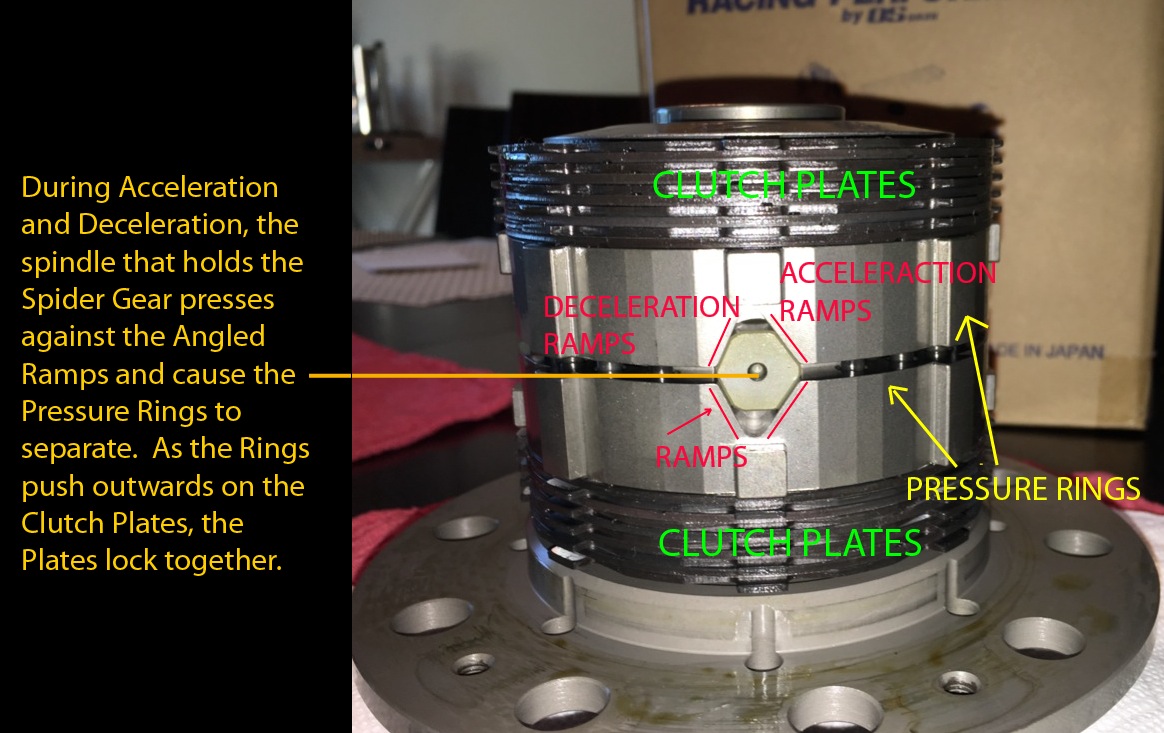
When the Pressure Rings spread apart, they press harder against the clutch plates. This spreading pressure creates enough friction between the plates that they start to lock or bind together. As the plates lock together, the axle locks and the two wheels move in unison. When the force being applied to the diff unit is reduced, the Pressure Rings relax inward back to their natural state and the pressure inside the diff is reduced and the plates are able to slide past each other again, and the differential opens again and the wheels can move at different rates around the corner. A unit like the OSG is able to lock and unlock very quickly if you want, depending on how it's setup. And while the stock M3 unit can only lock on acceleration, the clutch-type OSG can provide locking on both acceleration and deceleration if you set it up that way. Locking both rear wheels on decel provides very nice stability during braking----it feels like a parachute is slowing the car.
In general, people say a more performance-oriented diff makes your gas pedal feel more "connected" to the rear wheels. This is because a clutch-type LSD can lock and unlock quickly transferring power where you want it, which reduces the lag you may feel in a speed sensing diff, where first it needs to spin up, then it has to realize that it did, then it takes a few moments to start sending power to the other wheel.
What I was afraid of was a performance-oriented differential that would lock too fast and too hard when getting on the gas. The problem with a super fast or super touchy diff is that it can send a car sideways very quickly---especially if your car has a lot of power, so I didn't want it to be too touchy. With a supercharger in my car, I was concerned about a lot of power coming on very quickly and making the car unpleasant to drive if too much locking happens too fast. Plus, if you don't like how it feels, making physical changes to a diff is expensive because of how involved pulling it out is, sending the unit back to OSG and paying them change it, and then putting that all back together again…..Obviously, it would be great if the first assembly was something that I liked, but it's impossible to know. You just have to try it and see. It turns out this can be a very subjective topic.
My OSG diff could have been setup a bunch of ways. I chose what is called a "1.5 way" setup. A 1-way only locks on acceleration. A 2-way locks equally on acceleration and deceleration. A 1.5-way locks on acceleration and deceleration, but it can lock less on deceleration and usually for a shorter period of time. In the picture above, you can see the 2 ramps outlined by the Red lines have different angles. The left ramps (decel) are steeper than the right ones. The steep Decel ramps make it harder for the spindle to separate Pressure rings, and the shallower Accel ramps make it easier for the Rings to spread. 1.5-way diffs seem generally popular with road course tracking because you want the locking on accel, but you only want some lock on initial decel. And you want to MAKE SURE that the diff is open as you start turning that steering wheel to enter a corner. If a diff is still locked as you enter a corner, you will get unwanted understeer. When two rear wheels are locked together and spin at the same rate, they tend to want to go straight----even if the front wheels are turned. Again, this is great for initial braking, but terrible for corner entry. So, a 1.5-way diff gives you some initial lock when the brakes are applied but as the decel force is reduced and you're thinking about getting into that corner, you want the thing to be open as much as possible.
At this point, you may say to yourself: the theory is fine, but how practical is all of this? The answer is: It is quite practical. The diff has a LOT to do with the character and feel of a car.
In the next Part, I'll show data from the AIM that shows what was going on in the car with the stock diff, and what is happening now.