
57.9KVIEWS
158REPLIES
134APPRECIATES
07-28-2026LAST POST
Yeah did a TD earlier this year and both my passenger and I were amazed at how aggressively I could attack the kerbs and the TracTive would just soak it up. Car remained extremely settled even when it felt like two wheels were catching air. And this was running my Track setting which was nearly full hard on damping.

At no point in time have I ever felt that the TracTive was under sprung despite using even softer springs than stock. This was very unlike my previous Ohlins R/T which immediately felt under sprung on track even on full hard setting (2-4 clicks). TracTive is a system you really cannot judge just by looking at spec sheets and spring rates. It drives very differently to what you would expect from any other suspension set up with similar spring rates. As I said in my reviews earlier, the TracTive valve does offer quite a lot of spring rate thru the adjustable damping.

Here's a pic of me riding Sepang T12 kerb quite aggressively. Looks like I'm about to fly off but felt totally in control.
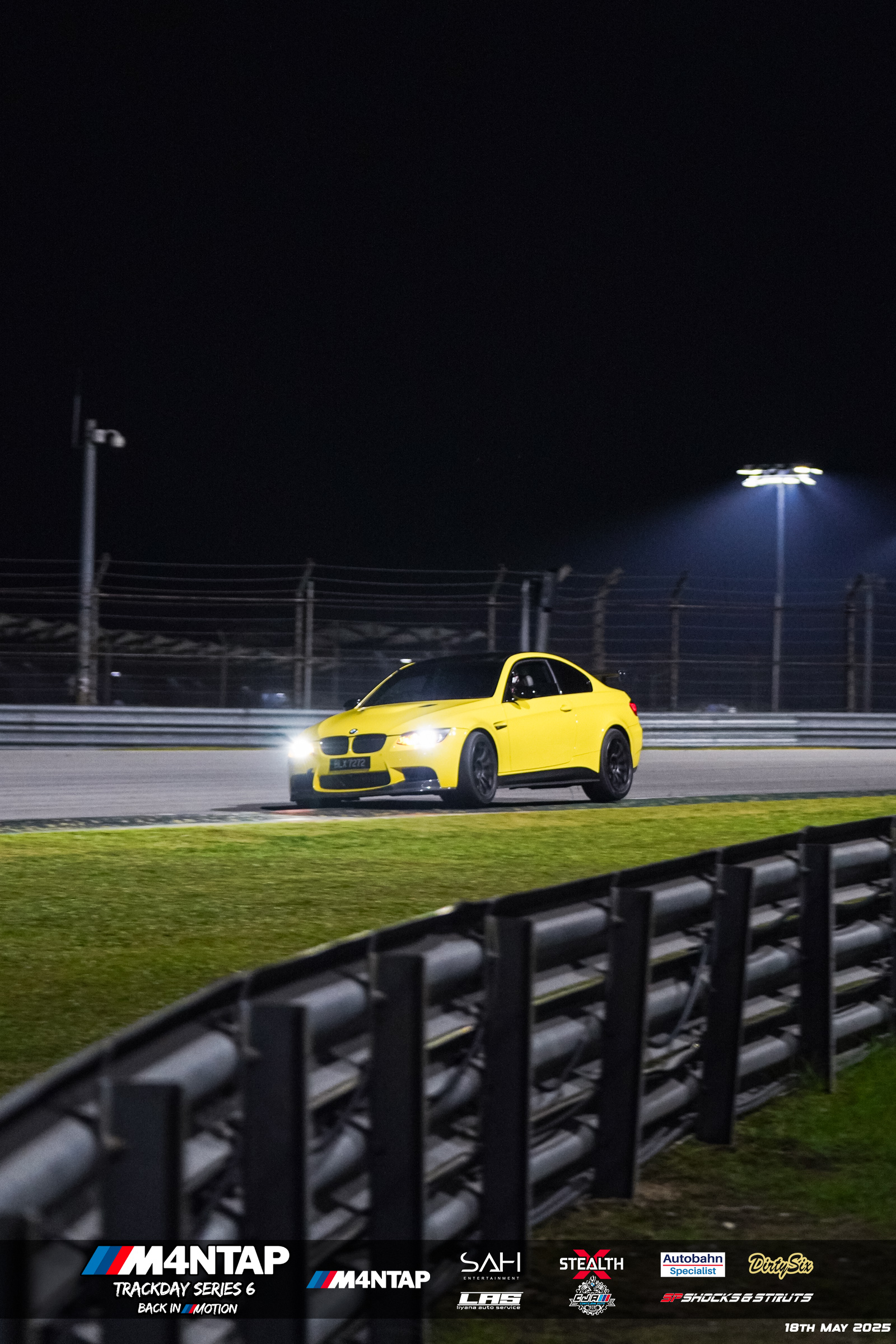
Attached image
That's amazing... it really sounds like magic... lol
changster wrote
That's amazing... it really sounds like magic... lol
What’s interesting is TracTive uses much stiffer non-flat-ride front spring rates and switches to a rear c/o spring on the Track Line. Converting the Track Line and Touring Line rear spring rates to wheel rates, the rear c/o wheel rate is stiffer than the Touring Line rear divorced wheel rate. So the Track Line increases the front spring rate by ~2-3x (depending on which front Touring Line rate is selected) and increases the rear c/o spring wheel rate by ~67%. From the picture, it clearly shows more roll stiffness is needed and that’s exactly what the Track Line does. This agrees with other e9x M and f8x high-end damper setups - a higher front sprung frequency is a quicker track setup and flat ride performs best on the street.
For sure more spring rate will be beneficial for a dedicated track car, especially if you're running aero. For a mainly street driven car with occasional trackdays and hill runs I really got no complaints about the TracTive Touring.
Redd's user avatarRedd Are you in the 2:20's at Sepang?
changster wrote
Redd's user avatarRedd Are you in the 2:20's at Sepang?
Oh hell no. Not even close. Driver issue haha. I stopped chasing laptimes when I got into the 2:30s and just drive for fun now. Most of the E9x M3 2:20s laptimes are set by private cars with professional race drivers. The same race driver actually lol. I know all the car owners.
Redd wrote
Oh hell no. Not even close. Driver issue haha. I stopped chasing laptimes when I got into the 2:30s and just drive for fun now. Most of the E9x M3 2:20s laptimes are set by private cars with professional race drivers. The same race driver actually lol. I know all the car owners.
Gotcha... well your car is a full weight street car so 2:20's is really tough.

I think GT4 Clubpsorts (factory race car) is like 2:15's or something.
Any further thoughts on this setup? Does the Tractive setup change the “feel” of the car negatively as opposed to an analog setup like Ohlins? Not sure if that makes sense, but I would imagine the car feels quite different if it behaves very flat through corners.

Thinking about picking a set up for primarily weekend and rare track duty.

Appreciate all the time you’ve put into documentation, one of the few sources of info available.
e90_503 wrote
Any further thoughts on this setup? Does the Tractive setup change the “feel” of the car negatively as opposed to an analog setup like Ohlins? Not sure if that makes sense, but I would imagine the car feels quite different if it behaves very flat through corners.

Thinking about picking a set up for primarily weekend and rare track duty.

Appreciate all the time you’ve put into documentation, one of the few sources of info available.
TracTive Touring & Tracking setups and Nitron elec-tron Roadsport & R1 are semi-active (rebound only) dampers that adjust damping in real time based on a control scheme (BMW EDC for the EDC plug-n-play option and a TracTive or Nitron standalone controller for non-EDC equipped cars). JRZ PROactive active dampers are currently being released for certain cars and are active in rebound and compression. I don’t know if JRZ are releasing EDC plug-n-play and standalone controller versions. The goal of active and semi-active dampers is to damp out suspension disturbances as quickly as possible by altering damping forces in a min 6 millisec (0.006 sec) duration . 99.9% of all drivers will not be able to notice any changes in damping. You’d need to be one of the most sensitive professional race-car drivers, or a F1-level racer, in the remaining 0.1% to have the sensitivity to truly detect the real-time changes in damping; however, a higher % may notice the final result (quicker return to the undisturbed equilibrium position) especially if driving cars back2back with semi-active and passive/conventional dampers.

Semi-active dampers do not make a car ride more flatly through a corner. Roll stiffness is controlled by spring rates and ASB stiffness; i.e., amount of chassis rotation about the longitudinal axis of the car. Similarly, spring rates control pitch and heave/bounce motions. So stiffness controls rotation and displacement motions. Dampers, on the other hand, produce damping forces that are proportional to damper piston rod velocities so damping controls how quickly or slowly weight and/or inertia is transferred. Simplistically, stiffness defines “flat” while damping controls how long it takes to reach “flat”. A lot of drivers like high low-speed damping (piston velocity < 3 in/s) because it gives a driver a higher level of confidence.
M3SQRD wrote
Semi-active dampers do not make a car ride more flatly through a corner.
I would disagree with this, at least for TracTive Touring. The roll and pitch control definitely work and is very noticeable. Pitch control is the most easily felt and the difference is quite big between min and max settings. At max, there is zero nose dive on braking - touch the brake pedal and you feel the car decelerate immediately. With passive dampers (eg Ohlins) you feel the front spring compress first (nose dive) before the car starts to slow down.

Maybe this body/pitch control is more apparent with the standalone ACE controller cos I can manually change the roll and pitch settings. But it's definitely noticeable.
e90_503 wrote
Any further thoughts on this setup? Does the Tractive setup change the “feel” of the car negatively as opposed to an analog setup like Ohlins? Not sure if that makes sense, but I would imagine the car feels quite different if it behaves very flat through corners.
Nothing new to report other than what I've already written at length in this thread. Still very happy with my TracTive. Ohlins still has the edge for sheer comfort (DFV and longer travel) but everywhere else the TracTive is better. Your use case is like mine and I think you will enjoy the TracTive.
Redd wrote
I would disagree with this, at least for TracTive Touring. The roll and pitch control definitely work and is very noticeable. Pitch control is the most easily felt and the difference is quite big between min and max settings. At max, there is zero nose dive on braking - touch the brake pedal and you feel the car decelerate immediately. With passive dampers (eg Ohlins) you feel the front spring compress first (nose dive) before the car starts to slow down.

Maybe this body/pitch control is more apparent with the standalone ACE controller cos I can manually change the roll and pitch settings. But it's definitely noticeable.
Well, it’s how things work.

So explain what’s preventing the car from rolling farther when the damper piston velocity drops to zero if, as you claim, damping is limiting/holding body roll, not rotational stiffness; i.e., what’s the damping force during steady-state handling?
M3SQRD wrote
Well, it’s how things work.

So explain what’s preventing the car from rolling farther when the damper piston velocity drops to zero if, as you claim, damping is limiting/holding body roll, not rotational stiffness; i.e., what’s the damping force during steady-state handling?
Honestly I don't have the degree of knowledge of how it all works as you do. I'm just sharing how it feels to me as the driver. You're right, a rebound-only semi-active (or active) damper should not have any effect on compression (pitch and roll). But somehow it does.

It's definitely not the roll bars (no change from before) nor the TracTive springs (softer than Ohlins). If it was at max damper travel and riding on the bumps I wouldn't be able to vary how much pitch/roll I want with the controller. So to my basic layman understanding that tells me the TracTive valve is adding some sort of compression control.

Sorry if I can't explain any deeper than that.
Redd wrote
Honestly I don't have the degree of knowledge of how it all works as you do. I'm just sharing how it feels to me as the driver. You're right, a rebound-only semi-active (or active) damper should not have any effect on compression (pitch and roll). But somehow it does.

It's definitely not the roll bars (no change from before) nor the TracTive springs (softer than Ohlins). If it was at max damper travel and riding on the bumps I wouldn't be able to vary how much pitch/roll I want with the controller. So to my basic layman understanding that tells me the TracTive valve is adding some sort of compression control.

Sorry if I can't explain any deeper than that.
Again, a semi-active damper does not helpbecause it cannot help with steady-state cornering. This is true for any type of damper. A damper is not a spring (well, a quality damper does not act like a spring and none are with zero piston velocity unless the hydraulic fluid is no longer a fluid). My guess is what you are feeling is a damper with a higher %, of critical, damping at corner entry; i.e., transient is damped out more quickly. BTW, when cornering the inside dampers do generate a rebound force at initial corner entry. Adjusting rebound damping, in particular on the rear, can reduce under at corner entry.

No active or semi-active or passive/conventional damper generates rebound or compressive forces when the piston velocity is zero - damping force, Fd = C * Piston Velocity so for Piston Velocity = zero where C is the damping coefficient (i.e., the slope on the damping force vs. piston velocity PVP (peak velocity plot). The CVP (continuous velocity plot) shows how well the damper is generating continuous damping forces and how much hysteresis (think of it as how much lag the continuous force has relative to its instantaneous velocity/displacement) exists in the damper. An active or semi-active or passive/conventional damper C value does not change as the piston velocity continuously drops from corner entry until it reaches zero velocity at steady-state cornering unless there’s a bump between turn-in and steady-state cornering. This bump typically creates an instantaneous high-speed bump damping response (unlike bouncing off of curbs which produces a high-speed compressive force until it reaches the blow-off valve).
Redd wrote
Honestly I don't have the degree of knowledge of how it all works as you do. I'm just sharing how it feels to me as the driver. You're right, a rebound-only semi-active (or active) damper should not have any effect on compression (pitch and roll). But somehow it does.

It's definitely not the roll bars (no change from before) nor the TracTive springs (softer than Ohlins). If it was at max damper travel and riding on the bumps I wouldn't be able to vary how much pitch/roll I want with the controller. So to my basic layman understanding that tells me the TracTive valve is adding some sort of compression control.

Sorry if I can't explain any deeper than that.
+1 with Redd's user avatarRedd same setup here and the roll and pitch are greatly improved, very noticeable on driving
LOL…I’m not saying TracTive has poor roll and pitch (and heave) control. I sure hope it does given the soft rates used by the Touring setup. It would be useful to know what you are comparing the Touring roll and pitch control to? Just curious to know if you’ve actually used any true high-end conventional dampers. However, this discussion is limited to the claim that the Touring dampers with the standalone controller has higher roll control during steady-state cornering. Touring dampers do not have any of the crazy black magic used in F1 dampers. I’m saying steady-state roll control is limited to mechanical stiffness from the spring rates and equivalent axial/vertical stiffness of the ASB. TracTive Touring dampers do not contribute any additional roll stiffness to the mechanical roll stiffness during steady-state cornering. Fdamp = C x Piston Velocity. Touring dampers may have a very high low-speed damping coefficient, C (it’s typically between 70-80%, of critical, damping), that’s higher than a typical high-end damper but it still doesn’t increase the overall steady-state roll stiffness/control when the Piston Velocity is ZERO - Fdamp = Chigh x ZERO = ZERO So what is statically holding the roll angle to an angle < the static roll angle held by the springs and ASB at ZERO Piston Velocity?
Thanks folks. An expert driver, I am not remotely close. Just hoping to refresh the platform with something a little more modern in terms of tech and I think this checks the box while not being too crazy on NVH since it must still serve normal life duties.

Placed the order with inertia labs, now the wait begins!
e90_503 wrote
Placed the order with inertia labs, now the wait begins!
Congrats! Pls do a full review once you have it.
M3SQRD wrote
LOL…I’m not saying TracTive has poor roll and pitch (and heave) control. I sure hope it does given the soft rates used by the Touring setup. It would be useful to know what you are comparing the Touring roll and pitch control to? Just curious to know if you’ve actually used any true high-end conventional dampers. However, this discussion is limited to the claim that the Touring dampers with the standalone controller has higher roll control during steady-state cornering. Touring dampers do not have any of the crazy black magic used in F1 dampers. I’m saying steady-state roll control is limited to mechanical stiffness from the spring rates and equivalent axial/vertical stiffness of the ASB. TracTive Touring dampers do not contribute any additional roll stiffness to the mechanical roll stiffness during steady-state cornering. Fdamp = C x Piston Velocity. Touring dampers may have a very high low-speed damping coefficient, C (it’s typically between 70-80%, of critical, damping), that’s higher than a typical high-end damper but it still doesn’t increase the overall steady-state roll stiffness/control when the Piston Velocity is ZERO - Fdamp = Chigh x ZERO = ZERO So what is statically holding the roll angle to an angle < the static roll angle held by the springs and ASB at ZERO Piston Velocity?
I don't know, i'm not a suspension engineer as you look like you are, i just drive the car and share my feelings

i had and have KW and Bilstein on another cars and Tractive is far away in performance (and confort) on roads

that was the initial goal for me
--Aramis-- wrote
I don't know, i'm not a suspension engineer as you look like you are, i just drive the car and share my feelings

i had and have KW and Bilstein on another cars and Tractive is far away in performance (and confort) on roads

that was the initial goal for me
If that’s what you feel then you have critically or overly damped the sprung roll motion so the car will never reach its max roll angle. You’ll have more mechanical grip if you let the suspension do what it is supposed to do.

No comment on KW and Bilstein
Received the set yesterday. The instructions are pretty sparse. I've done shock/strut installs before, but not coilovers...

I was expecting a bit more instruction in terms of initial recommended ride height and spring pre-load settings. Does anyone have any feedback or references here? I figure I can eyeball the ride height based on the existing struts, but feels like the preload should be a set value?

Thanks in advance!
e90_503 wrote
Received the set yesterday. The instructions are pretty sparse. I've done shock/strut installs before, but not coilovers...

I was expecting a bit more instruction in terms of initial recommended ride height and spring pre-load settings. Does anyone have any feedback or references here? I figure I can eyeball the ride height based on the existing struts, but feels like the preload should be a set value?

Thanks in advance!
Interesting. Can you share the install guide? It doesn't seem to show up online anywhere. Or is it just paper??
